The FE Other Disciplines exam is the broad survey route. It is a good fit when your degree or work history does not sit neatly inside Civil, Mechanical, Electrical and Computer, Chemical, or Environmental. The challenge is not one impossible topic; it is moving cleanly between statics, fluids, thermo, circuits, materials, economics, safety, and instrumentation without losing your place. This guide gives you the topic map, the highest-return review order, and a 12-week plan for keeping that breadth manageable.
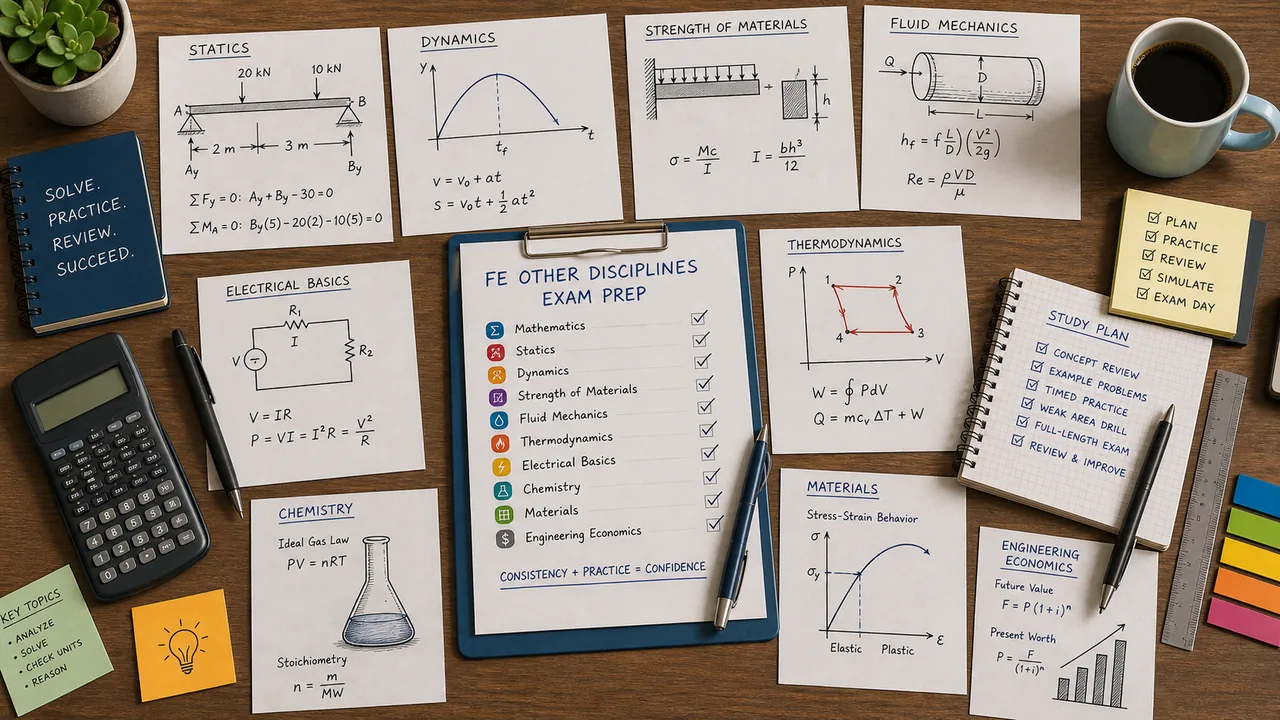
FE Other Disciplines Exam at a Glance
- 110 questions in 5 hours 20 minutes (computer-based, year-round)
- 14 topic areas spanning shared foundations and discipline-specific content
- High-weight areas: Mathematics, Statics, Strength of Materials, Thermodynamics, Electricity
- NCEES provides the FE Reference Handbook digitally — no outside notes allowed
- Most successful candidates study 200–300 hours over 8–16 weeks
What Is the FE Other Disciplines Exam?
NCEES administers the computer-based FE exam at Pearson VUE testing centers. You get 110 questions in 5 hours and 20 minutes, plus the digital FE Reference Handbook. Treat the handbook as part of the workflow: recognize the discipline behind the question, jump to the right section, and use the calculator carefully enough that broad review turns into steady points.
Passing the FE exam earns you the designation of Engineer Intern (EI) or Engineer in Training (EIT), the first step toward full PE licensure. Because the Other Disciplines exam tests breadth rather than depth, it is a strong choice for engineers whose undergraduate curriculum covered a wide range of engineering fundamentals without specializing in civil, mechanical, electrical, chemical, or environmental engineering.
What Are All 14 Topic Areas and Their Weights?
The FE Other Disciplines exam draws from 14 topic areas. Understanding these weights is essential for prioritizing your study time: fluids, mechanics, thermodynamics/heat transfer, and math deserve early attention, then the smaller breadth topics should rotate through your weekly plan.
Foundation Topics
| Topic Area | Est. Questions | NCEES Range | Priority |
|---|---|---|---|
| Mathematics | 8–12 | 8–12 questions | HIGH |
| Probability and Statistics | 6–9 | 6–9 questions | MEDIUM |
| Engineering Ethics and Societal Impacts | 5–8 | 5–8 questions | MEDIUM |
| Engineering Economics | 6–9 | 6–9 questions | MEDIUM |
Engineering Breadth Topics
| Topic Area | Est. Questions | NCEES Range | Priority |
|---|---|---|---|
| Chemistry | 5–8 | 5–8 questions | MEDIUM |
| Statics | 9–14 | 9–14 questions | HIGH |
| Strength of Materials | 9–14 | 9–14 questions | HIGH |
| Thermodynamics and Heat Transfer | 9–14 | 9–14 questions | HIGH |
| Basic Electrical Engineering | 6–9 | 6–9 questions | MEDIUM |
| Instrumentation and Controls | 4–6 | 4–6 questions | MEDIUM |
| Safety, Health, and Environment | 6–9 | 6–9 questions | MEDIUM |
| Dynamics | 9–14 | 9–14 questions | HIGH |
| Materials | 6–9 | 6–9 questions | MEDIUM |
| Fluid Mechanics | 12–18 | 12–18 questions | HIGH |
Highest-Return Core
- Fluid Mechanics (12–18 questions) — the largest single topic range in the FE Other specification
- Statics, Dynamics, and Strength of Materials (9–14 questions each) — the mechanics backbone of the exam
- Thermodynamics & Heat Transfer (9–14 questions) — energy balances, cycles, and heat-rate problems
- Mathematics (8–12 questions) — one of the highest-weight shared foundations
If you can consistently answer those topic areas, you are building the strongest part of your score. Below is a closer look at the major technical lanes and what to expect.
Where to Review the Highest-Return FE Other Disciplines Topics
The FE Other Disciplines exam rewards breadth, so this map groups the biggest lanes into a repeatable route. Review the concept only long enough to restart practice, then use the handbook guide and timed sets to build exam speed.
Sort energy and flow questions before calculating.
These topics carry a large share of the FE Other exam. Decide whether the problem is fluid statics, pipe flow, energy balance, cycle, conduction, convection, or radiation.
- Handbook move: mark fluids, thermo, and heat-transfer sections as one high-return cluster.
- Practice move: write the physical model and units before using equations.
Use mechanics as the backbone of broad review.
Free-body diagrams, equilibrium, stress, strain, kinematics, work-energy, and momentum show up across many engineering backgrounds. Build this cluster early.
- Handbook move: learn where mechanics references start and how they connect.
- Practice move: draw the system and coordinate direction before every calculation.
Keep the shared-topic base active every week.
Math, statistics, ethics, and economics are broad but predictable. They are also less dependent on your undergraduate specialty than many technical topics.
- Handbook move: mark math identities, distributions, and economic factors.
- Practice move: use calculator drills for matrices, regressions, and finance keys.
Learn the minimum viable circuit and measurement workflow.
For non-electrical candidates, circuit laws, power, sensors, controls, and instrumentation are often rusty. Focus on recognition, units, and simple circuit setup.
- Handbook move: group electrical equations, instrumentation terms, and controls references.
- Practice move: label voltage polarity and current direction before solving.
Use concept checks to cover the smaller breadth lanes.
Materials, chemistry, safety, health, and environment questions often test definitions, property trends, or straightforward formula use. They are good short-session topics.
- Handbook move: know where material properties, chemistry, and safety references sit.
- Practice move: rotate these topics in 20-minute blocks between heavier mechanics sets.
Source note: topic names and question ranges should be checked against the current NCEES FE exam page. External resources are optional review aids and may include material outside the FE exam scope.
Discipline-Specific Topics: What to Study
The FE Other Disciplines exam tests breadth rather than deep specialization, so questions tend to focus on foundational concepts and straightforward applications of key formulas.
1. Statics (9–14 questions)
What it covers: Free body diagrams, equilibrium of particles and rigid bodies, trusses (method of joints and method of sections), centroids, moments of inertia, friction, and distributed loads. Statics is the foundation for Strength of Materials and Dynamics, so mastering it early pays dividends.
Key formulas and concepts:
| Formula / Concept | Application |
|---|---|
| ΣFx = 0, ΣFy = 0, ΣM = 0 | Equilibrium equations (2D) |
| Method of joints / Method of sections | Truss member forces |
| x̄ = Σ(xiAi) / ΣAi | Centroid of composite areas |
| I = Σ(Ī + Ad²) | Parallel axis theorem for moment of inertia |
| Ff = μN | Coulomb friction |
Study priority: High. Statics is one of the most heavily weighted topics and the concepts are highly learnable through practice. Start every problem by drawing a clear free body diagram — most errors come from missing forces or incorrect sign conventions.
Common question patterns: You will be asked to determine support reactions for beams, find forces in truss members, locate the centroid of a composite shape, or calculate the moment of inertia using the parallel axis theorem. Expect problems that require setting up multiple equilibrium equations and solving simultaneously. Distributed loads are frequently converted to equivalent point loads for analysis.
2. Strength of Materials (9–14 questions)
What it covers: Normal and shear stress, axial deformation, beam bending (shear and moment diagrams), torsion of circular shafts, beam deflection, combined loading, Mohr’s circle for stress transformation, and column buckling using Euler’s formula.
Key formulas and concepts:
| Formula | Application |
|---|---|
| σ = P / A | Normal stress (axial loading) |
| δ = PL / AE | Axial deformation |
| σ = Mc / I | Flexure formula (beam bending stress) |
| τ = VQ / Ib | Shear stress in beams |
| τ = Tc / J | Torsional shear stress |
| Pcr = π²EI / (KL)² | Euler’s critical buckling load |
Study priority: High. This topic builds directly on Statics and carries equal weight on the exam. The key is developing a systematic approach: determine internal forces (shear and moment diagrams), then apply the appropriate stress or deflection formula.
Common question patterns: Calculate the maximum bending stress in a beam given a loading diagram. Draw shear and moment diagrams and identify the location of maximum moment. Find the angle of twist in a shaft under torsion. Use Mohr’s circle to determine principal stresses from a given state of stress. Calculate the critical buckling load for a column with given end conditions (pinned-pinned, fixed-free, etc.).
3. Thermodynamics and Heat Transfer (9–14 questions)
What it covers: The first and second laws of thermodynamics, ideal gas law, properties of pure substances, heat engines, refrigeration cycles, the Carnot cycle, conduction, convection, radiation, heat exchangers, psychrometrics, and phase diagrams.
Key formulas and concepts:
| Formula | Application |
|---|---|
| Q − W = ΔU | First law (closed system) |
| PV = nRT | Ideal gas law |
| η = Wnet / QH | Thermal efficiency |
| ηCarnot = 1 − TC/TH | Carnot cycle efficiency (absolute temps) |
| q = −kA(dT/dx) | Fourier’s law (conduction) |
| q = hA(Ts − T∞) | Newton’s law of cooling (convection) |
| q = εσA(Ts4 − Tsurr4) | Stefan-Boltzmann law (radiation) |
Study priority: High. This is one of the four most heavily weighted topics and connects to many real-world engineering applications. Focus on the first law for both closed systems and open systems (steady-state, steady-flow), ideal gas processes, and the three modes of heat transfer. Know when to use absolute temperature (Kelvin or Rankine) versus relative temperature.
Common question patterns: Calculate the work done or heat transferred in an ideal gas process. Determine the thermal efficiency of a heat engine or the COP of a refrigeration cycle. Find the heat transfer rate through a composite wall (conduction in series). Calculate the exit temperature of a fluid in a heat exchanger. Psychrometric problems may ask you to determine relative humidity, dew point, or wet-bulb temperature from given conditions.
4. Basic Electrical Engineering (6–9 questions)
What it covers: DC and AC circuit analysis, Ohm’s law, Kirchhoff’s voltage and current laws, series and parallel resistors, power calculations (real, reactive, and apparent power), power factor, transformers, motors and generators, magnetic fields, inductance, and capacitance.
Key formulas and concepts:
| Formula | Application |
|---|---|
| V = IR | Ohm’s law |
| P = IV = I²R = V²/R | DC power |
| ΣV = 0 (loop), ΣI = 0 (node) | Kirchhoff’s voltage and current laws |
| Z = R + jX | Impedance (AC circuits) |
| P = VI cosφ | Real power (AC) |
| PF = cosφ = P / S | Power factor |
| V1/V2 = N1/N2 | Ideal transformer turns ratio |
Study priority: High. Even if your background is not in electrical engineering, the circuits content on this exam is at an introductory level. Master Ohm’s law, series/parallel combinations, Kirchhoff’s laws, and basic AC power concepts. These are formula-driven problems that reward systematic practice.
Common question patterns: Find the current through or voltage across a resistor in a multi-loop DC circuit. Calculate the equivalent resistance of a series-parallel network. Determine real, reactive, and apparent power in an AC circuit given voltage, current, and phase angle. Calculate the secondary voltage of a transformer given the turns ratio. Expect problems on capacitor and inductor behavior in DC circuits (charging/discharging) and basic magnetic field calculations.
5. Instrumentation and Controls (4–6 questions)
What it covers: Sensors and transducers, signal conditioning, feedback control systems, transfer functions, block diagram algebra, stability criteria (Routh-Hurwitz, Bode plots), and system response characteristics (settling time, overshoot, steady-state error).
Key formulas and concepts:
| Formula / Concept | Application |
|---|---|
| G(s) = C(s) / R(s) | Transfer function (output/input in Laplace domain) |
| Closed-loop TF = G / (1 + GH) | Negative feedback system |
| ωn, ζ | Natural frequency and damping ratio (2nd-order systems) |
| Routh-Hurwitz criterion | Stability determination from characteristic polynomial |
Study priority: Medium. Controls can feel abstract if you have not taken a dedicated course, but the exam tests the basics. Focus on block diagram reduction, identifying stability from a transfer function, and understanding what damping ratio means for system response. Sensor questions tend to be conceptual — know the difference between thermocouples, RTDs, strain gauges, and pressure transducers.
Common question patterns: Reduce a block diagram to find the overall transfer function. Determine whether a system is stable using the Routh array. Identify the damping ratio and natural frequency of a second-order system from its transfer function. Conceptual questions about sensor types and their appropriate applications. Expect at least one question on the effect of adding proportional, integral, or derivative control action.
6. Safety, Health, and Environment (6–9 questions)
What it covers: OSHA regulations and standards, hazard identification and risk assessment, personal protective equipment (PPE), fire protection, electrical safety, confined space entry, lockout/tagout (LOTO) procedures, ergonomics, and industrial hygiene.
Key concepts:
| Concept | Application |
|---|---|
| OSHA hierarchy of controls | Elimination > Substitution > Engineering > Administrative > PPE |
| Lockout/tagout (LOTO) | Controlling hazardous energy during maintenance |
| Confined space classification | Permit-required vs. non-permit-required |
| NFPA fire classifications | Class A (ordinary), B (flammable liquids), C (electrical), D (metals) |
| PEL, TLV, TWA | Occupational exposure limits for chemicals |
Study priority: Medium. Safety questions are largely conceptual and regulation-based, which means they can be some of the easiest points on the exam if you review the key standards. Focus on the hierarchy of controls, LOTO procedures, confined space requirements, and fire classification. These topics appear consistently and require memorization rather than calculation.
Common question patterns: Identify the correct hierarchy of hazard controls for a given scenario. Determine when a confined space permit is required. Select the appropriate fire extinguisher class for a given fire type. Identify the correct PPE for a specific hazard. Expect scenario-based questions that test your understanding of OSHA requirements and best practices for workplace safety.
7. Dynamics (9–14 questions)
What it covers: Kinematics of particles (linear and rotational motion), Newton’s second law, work-energy theorem, conservation of energy, impulse-momentum theorem, conservation of momentum, and introductory vibrations (free and forced).
Key formulas and concepts:
| Formula | Application |
|---|---|
| F = ma | Newton’s second law |
| v = v0 + at, s = v0t + ½at² | Constant acceleration kinematics |
| T1 + U1→2 = T2 | Work-energy theorem |
| m1v1 + m2v2 = m1v1′ + m2v2′ | Conservation of momentum |
| ωn = √(k/m) | Natural frequency (undamped free vibration) |
Study priority: Medium. Dynamics builds on Statics by adding motion. If your statics fundamentals are solid, dynamics problems become much more approachable. Focus on particle kinematics, Newton’s second law applications, and energy/momentum methods. Vibrations questions typically test natural frequency calculations.
Common question patterns: Determine the velocity or position of a particle under constant acceleration. Apply Newton’s second law to find the acceleration of a system of connected bodies. Use the work-energy theorem to find the velocity of an object after falling a given distance. Calculate the final velocities after a collision using conservation of momentum. Find the natural frequency of a spring-mass system.
8. Materials (6–9 questions)
What it covers: Crystal structures (BCC, FCC, HCP), phase diagrams (binary, iron-carbon), mechanical properties (yield strength, ultimate strength, hardness, ductility, toughness), stress-strain curves, corrosion mechanisms and prevention, and properties of polymers, ceramics, and composites.
Key concepts:
| Concept | Application |
|---|---|
| Stress-strain curve regions | Elastic, plastic, necking, fracture — identify yield and UTS |
| Iron-carbon phase diagram | Identify phases (ferrite, austenite, cementite, pearlite) |
| E = σ / ε | Young’s modulus (slope of elastic region) |
| Galvanic series | Predicting corrosion when dissimilar metals are coupled |
| Hardness tests (Brinell, Rockwell, Vickers) | Measuring resistance to indentation |
Study priority: Medium. Materials science questions on the Other Disciplines exam tend to be conceptual rather than calculation-heavy. Know how to read a stress-strain curve, interpret the iron-carbon phase diagram, and identify basic corrosion mechanisms. Understand the tradeoffs between material classes (metals vs. polymers vs. ceramics vs. composites) for common engineering applications.
Common question patterns: Identify the yield strength and ultimate tensile strength from a stress-strain curve. Determine which phase exists at a given temperature and composition on the iron-carbon diagram. Identify the type of corrosion (galvanic, pitting, crevice, stress corrosion cracking) from a description. Select the best material for a given application based on required properties. Expect at least one question on crystal structure or the relationship between microstructure and mechanical properties.
9. Fluid Mechanics (12–18 questions)
What it covers: Fluid properties (viscosity, density, specific gravity), fluid statics (pressure, buoyancy, manometers), Bernoulli’s equation, the continuity equation, Reynolds number, laminar vs. turbulent flow, pipe flow (Darcy-Weisbach, Moody diagram), and open channel flow basics.
Key formulas and concepts:
| Formula | Application |
|---|---|
| P = ρgh | Hydrostatic pressure |
| P1/ρg + v1²/2g + z1 = P2/ρg + v2²/2g + z2 | Bernoulli’s equation |
| A1v1 = A2v2 | Continuity equation (incompressible flow) |
| Re = ρvD / μ | Reynolds number |
| hf = f(L/D)(v²/2g) | Darcy-Weisbach (pipe friction loss) |
Study priority: Medium. Fluid mechanics problems on this exam are at an introductory level. Focus on hydrostatic pressure, Bernoulli’s equation, the continuity equation, and Reynolds number. If you can confidently apply Bernoulli’s equation with the continuity equation, you can handle most fluid mechanics problems on the exam.
Common question patterns: Calculate the pressure at a given depth in a fluid. Apply Bernoulli’s equation to find the velocity or pressure at a point in a flow system. Determine whether flow is laminar or turbulent using the Reynolds number. Calculate head loss in a pipe using the Darcy-Weisbach equation with the Moody diagram. Buoyancy problems asking for the submerged fraction of a floating object or the force required to hold an object submerged.
Foundation Topics
Mathematics, probability, ethics, and engineering economics are compact compared with the technical breadth topics, but together they represent a significant portion of the exam. Do not neglect them.
Mathematics (8–12 questions)
This is the highest-weight shared topic. Expect questions on differential and integral calculus, ordinary differential equations, linear algebra (matrix operations, systems of equations), vector operations, and numerical methods. The reference handbook contains many of the formulas, but you need to know when and how to apply them. Practice integration techniques, separable and first-order linear ODEs, eigenvalue problems, and dot/cross product applications.
Probability and Statistics (6–9 questions)
Topics include probability distributions (normal, binomial, Poisson), expected value, standard deviation, hypothesis testing, linear regression, and confidence intervals. These problems are formula-driven — know where the formulas are in the reference handbook and practice applying them to word problems. Pay attention to when a one-tailed vs. two-tailed test is appropriate.
Engineering Ethics and Societal Impacts (5–8 questions)
This section covers the NCEES Model Rules of Professional Conduct, conflicts of interest, whistleblowing obligations, public welfare responsibilities, and professional competence standards. Ethics questions are conceptual and scenario-based — no formulas required. The guiding principle is that public safety always takes priority over client interests, employer directives, or personal gain. A few hours of review can earn you reliable points.
Engineering Economics (6–9 questions)
Topics include time value of money (present worth, future worth, annuities), net present value (NPV), internal rate of return (IRR), benefit-cost analysis, breakeven analysis, and depreciation methods (straight-line, MACRS). The factor tables are provided in the reference handbook. Focus on setting up cash flow diagrams correctly and selecting the right factor (P/F, P/A, A/P, etc.). These problems are highly formulaic and very scorable with practice.
12-Week Study Plan
This plan allocates roughly 20–25 hours per week (200–300 total hours). Adjust the pace to match your schedule, but preserve the sequence — later topics build on earlier ones.
Recommended 12-Week Schedule
Weeks 1–2: Mathematics Review + Start Statics
- Review calculus fundamentals: derivatives, integrals, differential equations
- Practice linear algebra: matrix operations, solving systems of equations
- Begin Statics: free body diagrams, equilibrium, support reactions
- Familiarize yourself with the FE Reference Handbook layout
Weeks 3–4: Strength of Materials + Dynamics
- Stress and strain, axial loading, beam bending, shear/moment diagrams
- Torsion, deflection, Mohr’s circle, column buckling
- Kinematics, Newton’s second law, work-energy, impulse-momentum
- Take a timed mini-quiz on Statics + Strength of Materials
Weeks 5–6: Thermodynamics + Fluid Mechanics
- First and second law, ideal gas processes, heat engines, Carnot cycle
- Conduction, convection, radiation, heat exchangers
- Fluid statics, Bernoulli’s equation, Reynolds number, pipe flow
- Practice psychrometric and phase diagram problems
Weeks 7–8: Electricity/Magnetism + Materials Science
- DC circuits: Ohm’s law, Kirchhoff’s laws, series/parallel analysis
- AC circuits: impedance, power factor, transformers
- Stress-strain curves, phase diagrams, corrosion, material selection
- Take a timed half-exam covering all topics studied so far
Weeks 9–10: Instrumentation/Controls, Safety, Ethics, Economics
- Transfer functions, block diagrams, stability, sensor types
- OSHA regulations, hierarchy of controls, LOTO, confined spaces
- NCEES Model Rules, professional conduct scenarios
- Time value of money, NPV, IRR, depreciation, benefit-cost analysis
- Review Probability and Statistics: distributions, hypothesis testing
Weeks 11–12: Full Practice Exams + Weak-Area Review
- Take two full-length, timed 110-question practice exams
- Analyze results: identify weak topics and review those sections
- Practice exam-day pacing (2.9 minutes per question)
- Review the reference handbook navigation one more time
- Rest the day before the exam — you have prepared for this
Study Tips for the FE Other Disciplines Exam
- Learn the reference handbook inside out. The NCEES FE Reference Handbook is provided digitally during the exam. Practice navigating it during every study session. Know where the statics, thermodynamics, and circuits formulas are located so you can find them quickly under pressure.
- Use an approved calculator. The TI-36X Pro is the most popular NCEES-approved calculator for the FE exam. Practice with it until operations like matrix entry, equation solving, and unit conversions are automatic.
- Practice under timed conditions. You have roughly 2.9 minutes per question. Build your pacing instincts by working through problems with a timer. If a problem takes more than 4 minutes, flag it and move on.
- Leverage the breadth, not the depth. The Other Disciplines exam tests each topic at an introductory level. You do not need to be an expert in every area — you need to be competent across all of them. A few hours on each lower-weight topic can earn you enough points to pass.
- Prioritize the highest-return core. Fluids, statics, dynamics, strength of materials, thermodynamics/heat transfer, and math should get early, repeated practice before you spread out across the smaller breadth topics.
- TI-36X Pro Scientific Calculator — the most popular NCEES-approved calculator. Handles matrix operations, equation solving, and unit conversions essential for this broad exam.
- NCEES FE Reference Handbook — the official handbook provided digitally during the exam. Study with a print copy so you know exactly where every formula is located.
Final Thoughts
The FE Other Disciplines exam rewards breadth over depth. Every topic is tested at a foundational level, which means that structured, consistent preparation across all 14 areas is more effective than deep-diving into any single subject. Start with the highest-weight topics — fluids, statics, dynamics, strength of materials, thermodynamics/heat transfer, and math — then build outward to cover the remaining areas. Become fluent with the reference handbook, take timed practice exams under realistic conditions, and manage your time carefully on exam day. Your EIT designation is within reach.
FE Other Disciplines Hub • How to Pass • Practice Problems • Free Practice Questions • Best FE Exam Prep Books • Calculator Guide • Exam Day Checklist
Frequently Asked Questions
How many questions are on the FE Other Disciplines exam?
The FE Other Disciplines exam has 110 multiple-choice questions with a 5-hour, 20-minute time limit. That works out to about 2.9 minutes per question. The exam is computer-based and offered year-round at Pearson VUE testing centers.
What are the highest-weight topics on the FE Other Disciplines exam?
Fluid Mechanics is the largest single FE Other Disciplines topic at 12–18 questions. The next highest-return group is Statics, Dynamics, Strength of Materials, and Thermodynamics and Heat Transfer at 9–14 questions each, followed by Mathematics at 8–12 questions.
How long should I study for the FE Other Disciplines exam?
Most successful candidates study 200–300 hours over 8 to 16 weeks. A 12-week study plan is a good target, allowing you to cover all 14 topic areas systematically. Start with the high-weight topics like Statics and Strength of Materials, then build outward to cover foundational areas like Ethics, Economics, and Probability.
Is the FE Other Disciplines exam difficult?
The FE Other Disciplines exam is the broadest FE exam, covering 14 topic areas that span statics, dynamics, thermodynamics, circuits, materials science, and more. The breadth can be challenging, but each topic is tested at a fundamental, introductory level. With structured preparation, consistent practice, and familiarity with the reference handbook, most well-prepared candidates pass on their first attempt.
FE Electrical & Computer • FE Civil • FE Mechanical • FE Chemical • FE Environmental
Disclaimer: This guide is an independent educational resource and is not affiliated with, endorsed by, or sponsored by NCEES. The “Fundamentals of Engineering” exam, “FE” exam, and “NCEES” are trademarks of the National Council of Examiners for Engineering and Surveying. Exam specifications and content are subject to change; always refer to the official NCEES website for the most current information.
Ready to Start Practicing?
Practice the Other Disciplines workflow: identify the subject family, find the supporting formula or table, work the units, and review the miss by topic. FE Test Prep pairs broad FE questions with step-by-step solutions, key signals, visual diagrams, Quick Formula Reference support, and calculator help.