The FE Environmental exam is broad because environmental work is broad: water, wastewater, hydrology, groundwater, air, chemistry, risk, regulations, and the shared FE foundations all show up together. The good news is that many questions follow recognizable patterns. This guide gives you the topic map, the highest-return study order, the formulas worth practicing, and a 12-week plan that keeps the breadth from turning into noise.
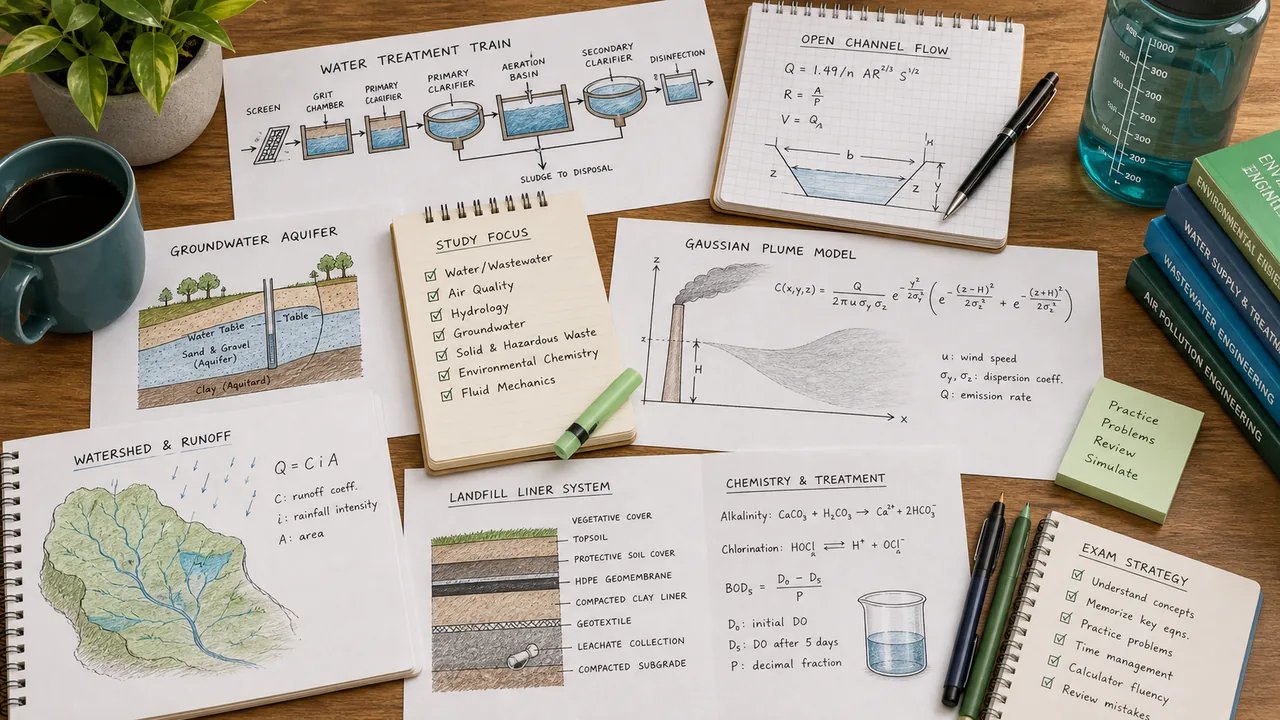
FE Environmental Exam at a Glance
- 67% first-time / 37% repeat pass rate (NCEES Squared 2025)
- $225 NCEES fee — see the full cost breakdown
- 110 questions in 5 hours 20 minutes (computer-based, year-round)
- 15 topic areas spanning shared foundations and discipline-specific content
- Highest-weight areas: Water and Wastewater (12–18 Q), Fluid Mechanics and Hydraulics (12–18 Q), Surface Water Resources and Hydrology (9–14 Q)
- NCEES provides the FE Reference Handbook digitally — no outside notes allowed
- A realistic plan often budgets 200–300 hours over 8–16 weeks
What Is the FE Environmental Exam?
NCEES administers the computer-based FE exam at Pearson VUE testing centers. You get 110 questions in 5 hours and 20 minutes, plus the digital FE Reference Handbook. Treat the handbook as part of the workflow: identify whether the problem is hydraulics, treatment, chemistry, air, groundwater, or risk, then move quickly to the formula, table, or unit conversion that matters. Our FE Environmental Handbook 10.6 page guide turns those lookup lanes into a printable one-page practice map.
Passing the FE exam earns you the designation of Engineer Intern (EI) or Engineer in Training (EIT), the first step toward full PE licensure. Environmental engineers with a PE license can sign environmental impact assessments, design treatment systems, and serve as the engineer of record on remediation projects.
What Are All 15 Topic Areas and Their Weights?
The FE Environmental exam draws from 15 knowledge areas defined in the NCEES exam specification (effective July 2020). Each topic has a published question-count range; understanding these weights is essential for prioritizing your study time. The table below uses the official NCEES ranges verbatim, with percentages computed against the 110-question exam.
| Topic Area | NCEES Questions | % of Exam | Priority |
|---|---|---|---|
| Water and Wastewater | 12–18 | 11–16% | HIGH |
| Fluid Mechanics and Hydraulics | 12–18 | 11–16% | HIGH |
| Surface Water Resources and Hydrology | 9–14 | 8–13% | HIGH |
| Groundwater, Soils, and Sediments | 8–12 | 7–11% | HIGH |
| Air Quality and Control | 8–12 | 7–11% | HIGH |
| Fundamental Principles | 7–11 | 6–10% | MEDIUM |
| Environmental Chemistry | 7–11 | 6–10% | MEDIUM |
| Solid and Hazardous Waste | 7–11 | 6–10% | MEDIUM |
| Mathematics | 5–8 | 5–7% | FOUNDATION |
| Ethics and Professional Practice | 5–8 | 5–7% | FOUNDATION |
| Engineering Economics | 5–8 | 5–7% | FOUNDATION |
| Health Hazards and Risk Assessment | 4–6 | 4–5% | FOUNDATION |
| Probability and Statistics | 4–6 | 4–5% | FOUNDATION |
| Energy and Environment | 4–6 | 4–5% | FOUNDATION |
| Thermodynamics | 3–5 | 3–5% | FOUNDATION |
The Big Five (49–74 questions, ~44–67% of the exam)
- Water and Wastewater (12–18 Q) — heavily formula-driven; CSTR/PFR mass balances, BOD, treatment unit sizing
- Fluid Mechanics and Hydraulics (12–18 Q) — Bernoulli, pipe and open-channel flow, pump calculations
- Surface Water Resources and Hydrology (9–14 Q) — Manning’s equation, rational method, unit hydrographs, flood frequency
- Groundwater, Soils, and Sediments (8–12 Q) — Darcy’s law, well hydraulics, contaminant transport, retardation
- Air Quality and Control (8–12 Q) — Gaussian plume dispersion, control device sizing, emissions factors
If you can consistently answer these five topic areas correctly, you are well on your way to passing. Below is a detailed look at each discipline-specific topic and what to expect.
Where to Review the Highest-Return FE Environmental Topics
Environmental prep has several large applied systems. Use this map to keep the exam-spec topics tied to handbook lookup, then use public agency resources for conceptual refreshers when regulations, water systems, or air-quality context feels fuzzy.
Pair treatment concepts with mass-balance practice.
Treatment questions often mix flow, concentration, BOD, reactor sizing, disinfection, solids handling, and unit-process concepts. Start every computational item with a flow and concentration map.
- Handbook move: mark water, wastewater, reactor, and chemistry lanes before timed practice.
- Practice move: keep units attached to every concentration and loading calculation.
Separate pipe energy, channel flow, and watershed runoff.
Environmental water problems frequently borrow from civil fluids and hydrology. Decide whether the governing idea is head loss, Manning flow, pump power, rainfall-runoff, or flood frequency.
- Handbook move: keep fluid and hydrology lookup lanes close in your review notes.
- Practice move: draw the water path and mark elevation, pressure, and flow before solving.
Use Darcy logic before contaminant-transport detail.
Groundwater items usually start with gradient, hydraulic conductivity, flow direction, well behavior, or retardation. Get the flow model right before adding chemistry.
- Handbook move: group groundwater, soil, and contaminant transport references together.
- Practice move: write the gradient and direction before calculating a rate or travel time.
Know whether the problem is emissions, dispersion, or control.
Air questions often ask for a model input, concentration estimate, removal efficiency, stack concept, or control-device decision rather than a long derivation.
- Handbook move: mark air-quality, units, and environmental chemistry references.
- Practice move: identify source, pathway, receptor, and control device before calculating.
Do not let shared fundamentals become missed points.
Environmental chemistry, health risk, probability, economics, ethics, and energy topics are smaller individually, but they stabilize your score when the water and air sets are difficult.
- Handbook move: know the chemistry, probability, and economics starts before exam week.
- Practice move: review one small foundation topic in each weekly study block.
Source note: topic names and question ranges should be checked against the current NCEES FE exam page. External resources are optional review aids and may include material outside the FE exam scope.
What Are the Discipline-Specific Topics on the FE Environmental Exam?
Eleven of the fifteen NCEES topics are discipline-specific to environmental engineering; the remaining four (Mathematics, Probability & Statistics, Ethics, Engineering Economics) are shared across every FE exam. Below is a detailed look at each discipline-specific topic: what it covers, the key formulas, how to prioritize your time, and the question patterns to expect. Question ranges below are from the NCEES exam specification (effective July 2020), with percentages computed against the 110-question exam.
1. Fundamental Principles (7–11 Q, 6–10%)
What it covers: Mass and energy balances, stoichiometry, dimensional analysis, unit conversions, and the basic chemistry and biology that underpin environmental systems. This topic tests whether you can set up and solve the conservation equations that appear throughout the rest of the exam.
Key formulas and concepts:
| Formula | Application |
|---|---|
| Qin × Cin = Qout × Cout + rV | General mass balance with reaction term |
| Accumulation = In − Out + Generation − Consumption | General mass balance statement |
| C = C0e−kt | First-order decay |
Study priority: High. This is the foundation for nearly every other topic. If you can confidently set up a mass balance for any system — a reactor, a lake, a treatment unit — you will find the rest of the exam significantly easier.
Common question patterns: You will be given a system with known inflows, outflows, and concentrations, and asked to find an unknown concentration or flow rate. Expect problems that combine mass balance with first-order reaction kinetics. Watch for steady-state vs. non-steady-state distinctions — the exam will test whether you know when to set accumulation to zero.
2. Environmental Chemistry (7–11 Q, 6–10%)
What it covers: Chemical equilibrium, acid-base chemistry, solubility and precipitation, oxidation-reduction (redox) reactions, chemical kinetics, and organic chemistry fundamentals relevant to environmental pollutants.
Key formulas and concepts:
| Formula | Application |
|---|---|
| pH = −log[H+] | pH calculation |
| Ka = [H+][A−] / [HA] | Acid dissociation constant |
| Ksp = [Mn+][Xm−] | Solubility product |
| t1/2 = 0.693 / k | Half-life for first-order reactions |
Study priority: Medium. Environmental chemistry is conceptually dense but the exam questions tend to be formula-driven. Focus on equilibrium calculations, pH problems, and reaction kinetics rather than trying to memorize all of organic chemistry.
Common question patterns: Expect pH calculations for weak acids/bases, solubility problems asking whether a precipitate will form, and kinetics problems asking you to determine a rate constant or half-life from experimental data. Redox problems may ask you to balance reactions or determine electron transfer.
3. Health Hazards and Risk Assessment (4–6 Q, 4–5%)
What it covers: The four-step risk assessment framework (hazard identification, exposure assessment, dose-response assessment, risk characterization), exposure pathways, carcinogenic and non-carcinogenic risk calculations, toxicology fundamentals, and epidemiology basics.
Key formulas and concepts:
| Formula | Application |
|---|---|
| Risk = CDI × SF | Cancer risk (excess lifetime cancer risk) |
| HQ = CDI / RfD | Hazard quotient (non-cancer risk) |
| HI = ∑HQ | Hazard index (multiple chemicals) |
| CDI = (C × IR × EF × ED) / (BW × AT) | Chronic daily intake |
Study priority: Medium. The risk assessment framework is very systematic and formulaic. Once you understand the four steps and the CDI equation, these problems are among the most predictable on the exam.
Common question patterns: You will be given exposure parameters (concentration, intake rate, body weight, exposure duration) and asked to calculate the chronic daily intake, cancer risk, or hazard quotient. Some questions test whether you understand the difference between carcinogenic and non-carcinogenic risk assessment approaches. Know that HQ > 1 indicates a potential concern and that cancer risks are typically compared against a threshold of 10−6 to 10−4.
4. Fluid Mechanics and Hydraulics (12–18 Q, 11–16%)
What it covers: Fluid properties, hydrostatics, Bernoulli’s equation, continuity equation, pipe flow (Darcy-Weisbach equation, Moody diagram, Hazen-Williams), open channel flow (Manning’s equation, critical flow), pump systems, and hydraulic structures.
Key formulas and concepts:
| Formula | Application |
|---|---|
| Q = (1/n) A R2/3 S1/2 | Manning’s equation (open channel flow) |
| hf = f (L/D)(v²/2g) | Darcy-Weisbach (pipe friction loss) |
| P1/γ + v1²/2g + z1 = P2/γ + v2²/2g + z2 | Bernoulli’s equation |
| Re = ρvD / μ | Reynolds number |
Study priority: High. Fluid mechanics and hydraulics problems are heavily represented and connect directly to hydrology, water treatment, and wastewater topics. If you are strong in this area, it pays dividends across multiple topic areas.
Common question patterns: Manning’s equation problems (calculate discharge in an open channel given geometry and slope), pipe flow problems (find head loss or required pipe diameter), and pump sizing problems. Know how to calculate the hydraulic radius for different channel geometries (rectangular, trapezoidal, circular). Understand the difference between laminar and turbulent flow and when to use each friction equation.
5. Thermodynamics (3–5 Q, 3–5%)
What it covers: First and second laws of thermodynamics, energy balances, enthalpy, entropy, phase equilibria, heat transfer fundamentals, and combustion.
Key formulas and concepts:
| Formula | Application |
|---|---|
| Q = mcΔT | Sensible heat transfer |
| ΔG = ΔH − TΔS | Gibbs free energy |
| η = Wout / Qin | Thermal efficiency |
Study priority: Lower. Thermodynamics carries the fewest questions of any discipline-specific topic (3–5), but the problems are typically straightforward energy balance or efficiency calculations. Do not skip it entirely — a few hours of focused study can earn you reliable points.
Common question patterns: Energy balance problems for heating or cooling systems, combustion calculations for air pollution applications, and phase change problems. You may be asked to calculate the heat required to raise the temperature of a fluid or the efficiency of an energy conversion process.
6. Surface Water Resources and Hydrology (9–14 Q, 8–13%)
What it covers: The hydrologic cycle, rainfall-runoff relationships, the rational method, unit hydrographs, flood frequency analysis, reservoir and channel routing, stream flow measurement, and water quality in surface waters.
Key formulas and concepts:
| Formula | Application |
|---|---|
| Q = CiA | Rational method (peak runoff) |
| Q = (1/n) A R2/3 S1/2 | Manning’s equation (channel flow) |
| Tr = 1 / P(exceedance) | Return period |
| S = (1000/CN) − 10 | SCS curve number method (retention) |
Study priority: Very high. This is one of the highest-weight topics on the exam at 9–14 questions. Master the rational method, Manning’s equation, and unit hydrograph construction. These formulas appear repeatedly.
Common question patterns: Calculate peak discharge using the rational method given a runoff coefficient, rainfall intensity, and drainage area. Determine flow in a channel using Manning’s equation. Construct or apply a unit hydrograph. Calculate the return period for a flood event from historical data. Expect problems that combine hydrology with hydraulics — for example, sizing a culvert or storm drain for a design storm.
The rational method formula Q = CiA uses specific units: Q in cfs when i is in inches/hour and A is in acres (in US customary). Mismatched units are one of the most common errors. Always check which unit system the problem is using before substituting values.
7. Groundwater, Soils, and Sediments (8–12 Q, 7–11%)
What it covers: Darcy’s law, aquifer types and properties (hydraulic conductivity, transmissivity, storativity, specific yield), well hydraulics (Thiem and Theis equations), contaminant transport (advection, dispersion, retardation, biodegradation), soil classification, and sediment transport.
Key formulas and concepts:
| Formula | Application |
|---|---|
| Q = KiA | Darcy’s law (groundwater flow) |
| v = Ki / ne | Seepage velocity (average linear velocity) |
| T = Kb | Transmissivity |
| R = 1 + (ρbKd) / n | Retardation factor |
| vc = v / R | Contaminant velocity (with retardation) |
Study priority: High. Groundwater problems are formula-driven and very learnable. Darcy’s law is the foundation — make sure you can apply it to confined aquifers, unconfined aquifers, and layered systems. Contaminant transport problems are increasingly common on the exam.
Common question patterns: Calculate groundwater flow rate through an aquifer using Darcy’s law. Determine the time for a contaminant to travel from a source to a well, accounting for retardation. Calculate drawdown at a pumping well. Expect problems that test your understanding of the difference between Darcy velocity (Q/A) and seepage velocity (Q/A/ne) — this distinction is a common exam trap.
8. Water and Wastewater (12–18 Q, 11–16%)
What it covers: Drinking water treatment (coagulation, flocculation, sedimentation, filtration, disinfection), wastewater treatment (primary, secondary, and tertiary processes), activated sludge design, reactor kinetics (CSTR, PFR, batch), BOD and COD, sludge handling and disposal, and regulatory standards.
Key formulas and concepts:
| Formula | Application |
|---|---|
| Cout = Cin / (1 + kτ) | CSTR with first-order reaction |
| Cout = Cin e−kτ | PFR with first-order reaction |
| Lt = L0(1 − e−kt) | BOD exerted at time t |
| τ = V / Q | Hydraulic detention time |
| θc = VX / (QwXr) | Solids retention time (SRT) |
| F/M = Q × S0 / (V × X) | Food-to-microorganism ratio |
Study priority: Critical. This is one of the two highest-weight topics on the exam at 12–18 questions (tied with Fluid Mechanics and Hydraulics). You must be fluent in reactor kinetics, BOD calculations, and treatment process design. Practice CSTR and PFR problems until the mass balance approach is automatic.
Common question patterns: Calculate the effluent concentration from a CSTR given influent concentration, detention time, and reaction rate constant. Determine BOD5 from ultimate BOD and rate constant. Size a sedimentation basin given flow rate and overflow rate criteria. Calculate the food-to-microorganism ratio for an activated sludge system. Determine the required chlorine dose for disinfection given CT requirements. Know the difference between BOD5 and ultimate BOD — this is a frequent source of errors.
The CSTR and PFR equations look similar but produce very different results. For the same detention time and reaction rate, a PFR always achieves higher removal than a CSTR for positive-order reactions. The exam frequently tests whether you can select the correct reactor model for a given scenario.
9. Air Quality and Control (8–12 Q, 7–11%)
What it covers: Atmospheric chemistry, criteria pollutants (PM, O3, CO, SO2, NOx, Pb), the Gaussian plume dispersion model, air pollution control devices (scrubbers, ESPs, baghouses, catalytic converters), emission calculations, indoor air quality, and regulatory standards (NAAQS, NSPS, HAPs).
Key formulas and concepts:
| Formula | Application |
|---|---|
| C = Q / (πuσyσz) × exp(−H² / 2σz²) | Gaussian plume (ground-level, centerline) |
| η = 1 − e−(w/v)A | Particle collection efficiency (ESP) |
| ppmv = (mg/m³)(24.45) / MW | Gas concentration conversion (at 25°C, 1 atm) |
Study priority: Medium. The Gaussian plume model is the single most important formula in this topic area. Understand the variables (emission rate Q, wind speed u, dispersion coefficients σy and σz, effective stack height H) and how atmospheric stability classes affect dispersion. Control device problems are typically conceptual — know which device is best for which pollutant type.
Common question patterns: Calculate the ground-level concentration at a given downwind distance from a stack using the Gaussian plume equation. Determine the collection efficiency of a pollution control device. Convert pollutant concentrations between ppm and mg/m³. Identify which criteria pollutant is associated with which health effect or source. Expect at least one question that requires interpreting atmospheric stability classes.
10. Solid and Hazardous Waste (7–11 Q, 6–10%)
What it covers: Solid waste characterization and generation rates, landfill design (liner systems, leachate collection, gas management, closure), composting, recycling, hazardous waste regulations (RCRA, CERCLA/Superfund), waste minimization hierarchy, and remediation technologies.
Key formulas and concepts:
| Formula | Application |
|---|---|
| L = P(A)(PERC) | Leachate generation rate |
| Vgas = L0 × M × (e−kt1 − e−kt2) | Landfill gas generation (EPA LandGEM model) |
| Waste hierarchy: Reduce > Reuse > Recycle > Recover > Dispose | Waste minimization priority |
Study priority: Medium-low. This topic is a mix of calculations and regulatory knowledge. Know the basics of landfill design (liner requirements, leachate collection, gas management) and the key regulatory frameworks (RCRA for active management, CERCLA for cleanup of contaminated sites). The waste hierarchy is a commonly tested concept.
Common question patterns: Calculate the leachate generation rate for a landfill given precipitation and area. Determine whether a waste is classified as hazardous under RCRA (ignitability, corrosivity, reactivity, toxicity). Identify the appropriate remediation technology for a given contamination scenario. Expect regulatory questions that test your knowledge of RCRA vs. CERCLA jurisdictions.
11. Energy and Environment (4–6 Q, 4–5%)
What it covers: Conventional and renewable energy sources, environmental impacts of energy production (air emissions, thermal pollution, land use), energy efficiency and conservation, lifecycle assessment, carbon footprint calculations, and sustainability concepts.
Key formulas and concepts:
| Formula | Application |
|---|---|
| η = Energyout / Energyin | Energy conversion efficiency |
| CO2 emissions = fuel × EF | Emission factor approach |
Study priority: Lower. This is one of the lowest-weight topics and tends to be more conceptual than computational. A few hours reviewing energy source comparisons, basic efficiency calculations, and lifecycle assessment concepts should be sufficient.
Common question patterns: Compare the environmental impacts of different energy sources. Calculate energy efficiency or carbon emissions from a given fuel source. Identify renewable energy advantages and limitations. Expect questions on the environmental tradeoffs of energy production — for example, the water consumption of thermoelectric power plants or the land use impacts of solar farms.
Which Topics Should You Prioritize?
Not all 15 topics carry equal weight. A strategic study plan focuses your limited time where it will earn the most points:
- Water and Wastewater (12–18 Q, 11–16%) — tied for the single highest-weight topic; heavily formula-driven
- Fluid Mechanics and Hydraulics (12–18 Q, 11–16%) — tied for highest-weight; overlaps directly with hydrology and water treatment
- Surface Water Resources and Hydrology (9–14 Q, 8–13%) — rational method, Manning’s equation, unit hydrographs
- Groundwater, Soils, and Sediments (8–12 Q, 7–11%) — formula-driven, highly learnable, and frequently tested
- Air Quality and Control (8–12 Q, 7–11%) — Gaussian plume dispersion, control-device efficiency, emission factors
Together, these five topics account for roughly 44–67% of the entire exam. If you can consistently answer these correctly, you are well on your way to passing.
Next, address the medium-weight discipline-specific topics: Fundamental Principles (7–11 Q, 6–10%), Environmental Chemistry (7–11 Q, 6–10%), and Solid and Hazardous Waste (7–11 Q, 6–10%). These collectively represent another 21–30 questions (19–27% of the exam).
Finally, cover the lower-weight topics: Health Hazards and Risk Assessment (4–6 Q), Energy and Environment (4–6 Q), and Thermodynamics (3–5 Q), plus the four shared foundational topics (Mathematics, Probability & Statistics, Ethics & Professional Practice, Engineering Economics). While each carries fewer questions individually, the shared topics — especially Ethics and Engineering Economics — offer some of the easiest points on the exam with minimal preparation.
What Are the Key Formulas You Need to Know?
Here is a consolidated reference of the most important formulas across the entire FE Environmental exam. All of these appear in the NCEES FE Reference Handbook, but knowing where they are and when to apply them is what separates passers from repeaters:
| Formula | Topic | Application |
|---|---|---|
| QinCin = QoutCout + rV | Fundamental Principles | Mass balance with reaction |
| C = C0e−kt | Fundamental Principles | First-order decay |
| Cout = Cin / (1 + kτ) | Water & Wastewater | CSTR effluent concentration |
| Lt = L0(1 − e−kt) | Water & Wastewater | BOD exerted at time t |
| Q = KiA | Groundwater | Darcy’s law |
| Q = (1/n) AR2/3S1/2 | Fluid Mechanics / Hydrology | Manning’s equation |
| Q = CiA | Hydrology | Rational method |
| C = Q/(πuσyσz) exp(−H²/2σz²) | Air Quality | Gaussian plume (ground-level) |
| Risk = CDI × SF | Risk Assessment | Cancer risk |
| HQ = CDI / RfD | Risk Assessment | Hazard quotient |
What Study Tips Will Help You Pass?
- Learn the reference handbook inside out. The NCEES FE Reference Handbook is provided digitally during the exam. Practice navigating it during every study session. Know where the environmental engineering formulas are located and how the handbook organizes information by discipline.
- Use an approved calculator. The TI-36X Pro, Casio FX-115 series, and TI-30X series are popular choices. Environmental engineering problems frequently involve exponential functions, logarithms, and scientific notation — practice these operations until they are automatic.
- Practice under timed conditions. You have roughly 2.9 minutes per question. Build your pacing instincts by working through problems with a timer. If a problem is taking too long, flag it and move on.
- Focus on units. Environmental engineering problems mix units constantly — mg/L to kg/m³, cfs to gallons per day, acres to square meters. Carry your units through every calculation. If your answer has unreasonable units or magnitude, recheck before moving on.
- Understand the “why,” not just the “how.” The exam tests your ability to select the right approach, not just execute calculations. Know when to use a CSTR model vs. a PFR model, when Darcy’s law applies vs. when it does not, and which treatment process addresses which pollutant.
- TI-36X Pro Scientific Calculator — the most popular NCEES-approved calculator for the FE exam. Handles exponentials, logarithms, and unit conversions essential for environmental engineering problems.
- NCEES FE Reference Handbook — practice with the official digital handbook assigned to your exam date so search terms, section names, and formula context feel familiar.
Test-Day Strategy and Common Mistakes
A study plan wins points before exam day; execution protects them on it. FE Environmental was 67% first-time pass / 37% repeat in the NCEES Squared 2025 table. The exam's breadth means the margin usually comes down to pacing, clean units, and choosing the right model.
What to do on test day
- Arrive early. Pearson VUE centers require check-in with valid, unexpired ID. Give yourself at least 30 minutes before your appointment.
- Manage time aggressively. 110 questions in 320 minutes is under 3 minutes each. If a problem will take more than 4 minutes, flag it and move on.
- Answer every question. No penalty for wrong answers — a blank is a guaranteed zero, a guess is 25%. Always select something.
- Prioritize the water path. Many Environmental points come from fluids, hydrology, water/wastewater, and mass balances. Solve the clean flow, loading, and treatment problems first, then return to lower-frequency air, solid-waste, and risk questions.
- Reset your units at the break. The second half punishes tired unit handling — MGD to ft3/s, mg/L to lb/day, acre-ft to volume, log removal to percent removal. Come back deliberate.
- Use context on regulation-style questions. Environmental prompts often contain enough clues to eliminate answers that are wrong by process, contaminant, or exposure pathway before you even find the handbook entry.
The most common mistakes to avoid
- Spending too long on one question. The 4-minute rule: if you have no clear progress after four minutes, flag it and collect the easy points first.
- Neglecting the shared topics. Ethics, Economics, Mathematics, and Statistics together account for 16–24 questions and are among the easiest points on the exam.
- Not practicing with the reference handbook. The environmental sections hold reactor kinetics, Darcy's law, the Gaussian plume model, and risk-assessment equations. Make the handbook your primary reference in every practice session.
- Confusing similar formulas. CSTR vs. PFR mass balances, confined vs. unconfined aquifers, cancer risk vs. hazard quotient — the exam tests whether you pick the right equation, not just plug into it. (For the same detention time and rate constant, a PFR always removes more than a CSTR.)
- Ignoring process understanding. Know why a treatment process works and when to use it, not just how to calculate its loading.
- Cramming the night before. Last-minute cramming raises anxiety and cuts sleep. Do a light review at most, then rest.
Final Thoughts
The FE Environmental Engineering exam is challenging in its breadth, but every topic is learnable with structured preparation. Focus first on the highest-weight topics — Water and Wastewater, Fluid Mechanics and Hydraulics, Surface Water Resources and Hydrology, Groundwater/Soils/Sediments, and Air Quality and Control — then build outward to cover the full exam scope. Become fluent with the reference handbook, master the key formulas listed above, take timed practice exams under realistic conditions, and manage your time carefully on exam day. The environmental engineering discipline sits at the intersection of science, engineering, and public health, and your PE license will open doors to meaningful work protecting human health and the environment.
How to Pass the FE Environmental Exam • FE Environmental Practice Problems • Best FE Exam Prep Books • 🔢 Calculator Guide • ✅ Exam Day Checklist • Guide for Returning Engineers
Frequently Asked Questions
How many questions are on the FE Environmental exam?
The FE Environmental exam has 110 multiple-choice questions with a 5-hour, 20-minute time limit. That works out to about 2.9 minutes per question. The exam is computer-based and offered year-round at Pearson VUE testing centers.
What are the highest-weight topics on the FE Environmental exam?
According to the NCEES exam specification, the two highest-weight topics are Water and Wastewater and Fluid Mechanics and Hydraulics, each carrying 12–18 questions. Surface Water Resources and Hydrology (9–14 questions), Groundwater, Soils, and Sediments (8–12 questions), and Air Quality and Control (8–12 questions) round out the top five, together accounting for roughly 44–67% of the exam.
How long should I study for the FE Environmental exam?
A realistic FE Environmental plan often budgets 200–300 hours over 8 to 16 weeks. A 12-week study plan is a good target for many candidates. Start with the high-weight environmental topics, then cover foundational areas like math, ethics, and engineering economics.
Is the FE Environmental exam difficult?
The FE Environmental exam is broad, covering 15 topic areas from water treatment to air quality to ecology. Structured preparation and consistent reference-handbook practice put candidates in a stronger position on test day.
Related FE Environmental Guides
- FE Environmental exam overview — format, pass rate, and how the topic areas fit together
- FE Environmental practice problems — worked examples with full solutions
- How to pass the FE Environmental exam — study strategy and weak-area triage
- FE Reference Handbook navigation — find the right table fast on exam day
Disclaimer: This guide is an independent educational resource and is not affiliated with, endorsed by, or sponsored by NCEES. The “Fundamentals of Engineering” exam, “FE” exam, and “NCEES” are trademarks of the National Council of Examiners for Engineering and Surveying. Exam specifications and content are subject to change; always refer to the official NCEES website for the most current information.
Ready to Start Practicing?
Practice the Environmental workflow: recognize the water, wastewater, air, groundwater, chemistry, or risk pattern, find the supporting formula or table, and review the miss while it is still fresh. FE Test Prep pairs Environmental questions with step-by-step solutions, key signals, diagrams, Quick Formula Reference support, and calculator help.
Start the free FE Environmental diagnostic
Enter your email for FE Environmental study updates, then jump into the free 20-question diagnostic. No account needed.