The FE Mechanical exam is broad, but it is not random. Most points come from recognizing familiar setups in thermodynamics, fluids, dynamics, statics, mechanics of materials, heat transfer, and design, then finding the right equation or property quickly enough to stay on pace. This guide gives you the topic map, the highest-return study order, and a 12-week plan that keeps practice tied to real exam decisions.
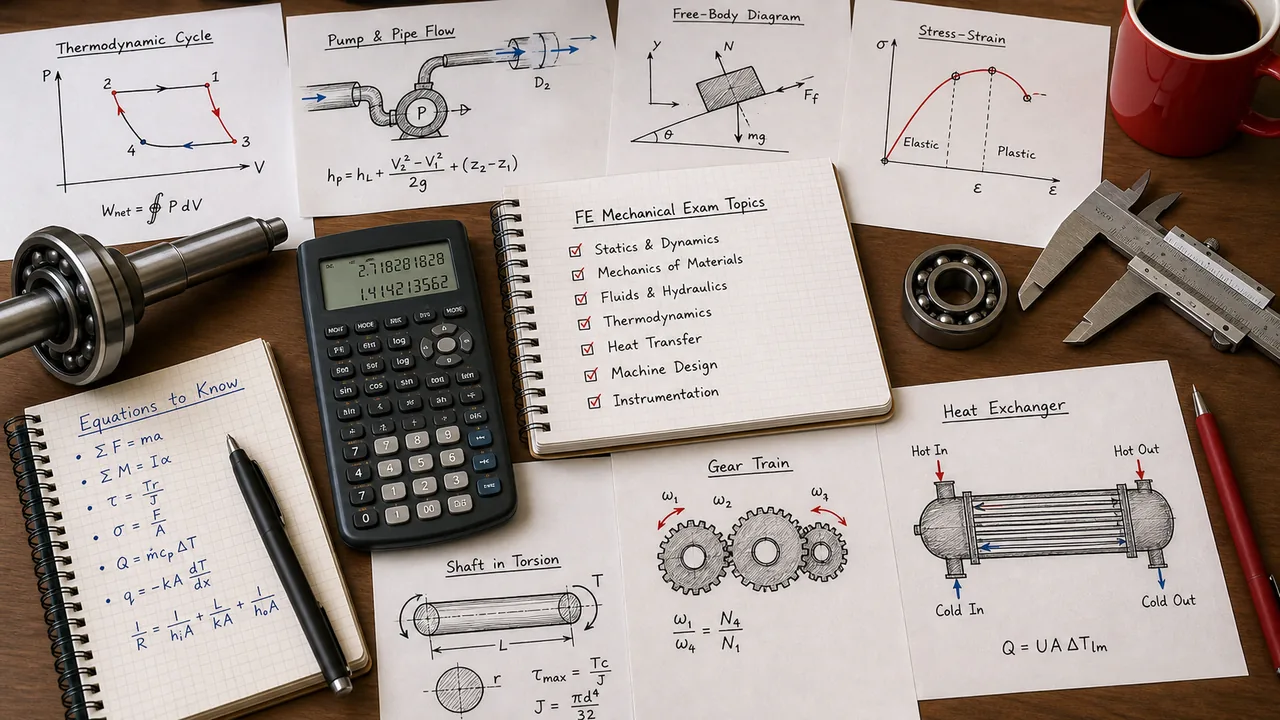
FE Mechanical Exam at a Glance
| Questions | 110 multiple-choice |
| Time | 5 hours 20 minutes (~2.9 min/question) |
| Format | Computer-based at Pearson VUE centers, year-round |
| Topic areas | 14 knowledge areas — 5 high-weight topics dominate |
| Reference | NCEES FE Reference Handbook (provided digitally) |
| Cost | $225 NCEES fee (full cost breakdown) |
| Pass rate | 69% first-time, 37% repeat (NCEES Squared 2025) |
| Study time | 200–300 hours over 8–16 weeks |
What Is the FE Exam and Why Does It Matter?
NCEES administers the computer-based FE exam at Pearson VUE testing centers. You get 110 questions in 5 hours and 20 minutes, plus the digital FE Reference Handbook. Treat that handbook as part of the test, not a backup plan: the faster you can recognize a cycle, beam, pump curve, vibration setup, or heat-transfer mode, the easier it is to choose the right formula and move.
Passing the FE exam earns you the designation of Engineer Intern (EI) or Engineer in Training (EIT), depending on your state. From there, after accumulating the required years of professional experience (typically four years under a licensed PE), you become eligible to sit for the PE exam and earn full licensure.
Career Benefits of Passing the FE Exam
- PE licensure pathway: A PE license is required to offer engineering services directly to the public, hold certain senior positions, and sign and seal engineering documents. In many industries — HVAC, power generation, manufacturing, and consulting — PE licensure is a significant differentiator.
- Competitive advantage: Even before you earn your PE, the EIT credential signals competence and commitment to employers. Many mechanical engineering firms expect new hires to have passed the FE or to pass it within their first year.
- Higher earning potential: Licensed professional engineers consistently earn higher salaries than their unlicensed peers, with many surveys showing a 10–20% premium (Bureau of Labor Statistics).
- Career mobility: Licensure is recognized across all 50 U.S. states and territories through comity agreements, making it easier to work in different jurisdictions.
What Are the 14 Topic Areas on the FE Mechanical Exam?
The FE Mechanical exam draws from 14 distinct knowledge areas. The first four topics are shared across all FE disciplines, while topics 5 through 14 are specific to the mechanical engineering exam. NCEES publishes an exam specification that assigns each topic an approximate number of questions out of 110. Below is a summary table followed by a detailed look at each topic.
| Topic Area | Est. Questions | Weight | Priority |
|---|---|---|---|
| Mechanics of Materials | 10–15 | 9–14% | HIGH |
| Statics | 7–11 | 6–10% | HIGH |
| Dynamics, Kinematics & Vibrations | 7–11 | 6–10% | HIGH |
| Fluid Mechanics | 7–11 | 6–10% | HIGH |
| Thermodynamics | 7–11 | 6–10% | HIGH |
| Heat Transfer | 7–11 | 6–10% | MEDIUM |
| Mechanical Design & Analysis | 3–5 | 3–5% | MEDIUM |
| Measurements, Instrumentation & Controls | 3–5 | 3–5% | MEDIUM |
| Material Properties & Processing | 4–6 | 4–6% | MEDIUM |
| Mathematics | 6–9 | 5–8% | FOUNDATION |
| Probability & Statistics | 4–6 | 4–6% | FOUNDATION |
| Ethics & Professional Practice | 4–6 | 4–6% | FOUNDATION |
| Engineering Economics | 4–6 | 4–6% | FOUNDATION |
| Computational Tools | 2–4 | 2–4% | FOUNDATION |
Where to Review the Highest-Return FE Mechanical Topics
Mechanical prep gets easier when you group topics by workflow instead of studying every chapter equally. Use this map to decide when to use the handbook, when to practice, and when an outside refresher is worth your time.
Treat loads, reactions, stress, and deflection as one chain.
A beam problem may start as statics and end as stress or deflection. Build the habit of finding reactions first, then moving to internal loads and material response.
- Handbook move: mark section properties, stress equations, torsion, and beam-deflection tools.
- Practice move: keep sign conventions visible on every beam and shaft problem.
Choose the model before choosing the equation.
Mechanical dynamics questions often hinge on whether the problem is particle motion, rigid-body rotation, work-energy, impulse-momentum, or one-degree vibration.
- Handbook move: separate kinematics, kinetics, and vibration references in your review notes.
- Practice move: draw the coordinate system and positive direction before calculating.
Write the system boundary and energy balance first.
Cycles, compressors, turbines, nozzles, heat exchangers, conduction, convection, and radiation all become cleaner once the control mass or control volume is clear.
- Handbook move: know where property tables, cycles, and heat-transfer relationships start.
- Practice move: track state numbers and units before using table values.
Identify pressure, energy, momentum, or loss before solving.
Fluids questions reward classification. Decide whether the problem is statics, Bernoulli, pipe loss, pump power, dimensional analysis, or momentum before opening the calculator.
- Handbook move: mark fluid-property, head-loss, pump, and dimensionless-number lanes.
- Practice move: convert all pressures and elevations into a consistent energy form.
Look for failure mode and material behavior first.
Design and materials questions often ask whether stress, fatigue, safety factor, material property, or manufacturing behavior controls the answer.
- Handbook move: connect design factors, material properties, and failure criteria.
- Practice move: state the failure mode before substituting values.
Source note: topic names and question ranges should be checked against the current NCEES FE exam page. External resources are optional review aids and may include material outside the FE exam scope.
Below is a detailed look at each topic area and what to expect.
Part 1: Shared Topics (All FE Disciplines)
1. Mathematics (6–9 questions)
Covers calculus (derivatives and integrals), differential equations, linear algebra, vector operations, and analytic geometry. You will encounter problems involving partial derivatives, solving first- and second-order ordinary differential equations, matrix operations, and vector cross and dot products. The NCEES FE Reference Handbook provides key formulas, but you need to know how to recognize which technique applies and execute it quickly. Math on the FE Mechanical exam carries more weight than on some other disciplines because it underpins thermodynamics, dynamics, fluid mechanics, and heat transfer.
2. Probability and Statistics (4–6 questions)
Expect questions on probability distributions (normal, binomial, Poisson), measures of central tendency and dispersion, linear regression, hypothesis testing, and confidence intervals. Mechanical engineers use statistics extensively in quality control, reliability engineering, and experimental analysis. Most problems are straightforward if you understand when to apply each distribution and how to use the standard normal table in the reference handbook.
3. Ethics and Professional Practice (4–6 questions)
Covers the NCEES Model Rules of Professional Conduct, ethical obligations, public safety considerations, and licensure requirements. These are conceptual rather than computational — you will be given scenarios and asked to identify the correct ethical course of action. Read the ethics section in the reference handbook carefully; it is a compact topic area where focused review can pay off.
4. Engineering Economics (4–6 questions)
Topics include time value of money, present and future worth analysis, annual cost comparisons, benefit-cost analysis, rate of return, breakeven analysis, and depreciation methods. Master the standard factor formulas (P/F, F/P, A/P, A/F, P/A, F/A) and you will handle these efficiently. Mechanical engineers routinely use economic analysis to compare equipment alternatives and justify capital expenditures.
Part 2: Mechanical Engineering–Specific Topics
5. Statics (9–14 questions)
One of the most heavily tested topics on the exam. Covers resultants of force systems, concurrent and non-concurrent forces, equilibrium of rigid bodies, analysis of trusses (method of joints and method of sections), frames and machines, centroids and moments of inertia, and friction. You must be able to draw free body diagrams confidently and solve equilibrium equations. This is a foundational topic — weaknesses here will cascade into Mechanics of Materials, Dynamics, and Mechanical Design. Subtopics include:
- Two- and three-dimensional force systems
- Equilibrium of particles and rigid bodies
- Truss analysis (method of joints, method of sections)
- Frames and machines
- Centroids and area moments of inertia
- Static and kinetic friction
6. Dynamics, Kinematics, and Vibrations (10–15 questions)
A major topic area that goes well beyond what other FE disciplines test. Covers particle and rigid body kinematics (rectilinear, curvilinear, and relative motion), kinetics using Newton’s second law, work-energy methods, impulse-momentum methods, impact (elastic and inelastic collisions), and vibrations (free, damped, and forced). Subtopics include:
- Rectilinear and curvilinear motion of particles
- Rotation and general plane motion of rigid bodies
- Newton’s second law for translation and rotation
- Work-energy theorem and conservation of energy
- Linear and angular impulse-momentum
- Free vibration: natural frequency, period, amplitude
- Damped vibration: underdamped, overdamped, critically damped
- Forced vibration: resonance and transmissibility
7. Mechanics of Materials (9–14 questions)
Another high-weight topic. Includes stress and strain (normal and shear), axial loading, torsion of circular shafts, bending stresses in beams, shear stresses in beams, combined loading, Mohr’s circle for stress and strain, beam deflections, statically indeterminate members, pressure vessels, and column buckling (Euler’s formula). Subtopics include:
- Stress-strain diagrams and material properties
- Axial deformation and thermal expansion
- Torsion of circular and thin-walled shafts
- Beam bending: flexure formula and shear formula
- Shear and bending moment diagrams
- Mohr’s circle for plane stress and plane strain
- Combined loading and principal stresses
- Thin- and thick-walled pressure vessels
- Euler column buckling and effective length
- Beam deflections (double integration, superposition)
8. Material Properties and Processing (4–6 questions)
Covers mechanical properties of metals, polymers, ceramics, and composites. Expect questions on the stress-strain curve (yield strength, ultimate strength, modulus of elasticity, ductility), hardness testing, fatigue life, creep, phase diagrams (iron-carbon), heat treatment processes (annealing, quenching, tempering), and corrosion mechanisms. Subtopics include:
- Mechanical properties: yield, ultimate, elastic modulus, Poisson’s ratio
- Iron-carbon phase diagram and heat treatments
- Fatigue, creep, and fracture mechanics fundamentals
- Material selection for engineering applications
- Manufacturing processes: casting, forming, machining, joining
9. Fluid Mechanics (10–15 questions)
Covers fluid properties (density, viscosity, surface tension, compressibility), fluid statics and manometry, buoyancy, the Bernoulli equation, the continuity equation, pipe flow with friction losses (Darcy-Weisbach and Moody diagram), Reynolds number, dimensional analysis, external flow (drag and lift), and turbomachinery. Subtopics include:
- Fluid statics: pressure variation, manometers, forces on submerged surfaces
- Buoyancy and stability of floating bodies
- Conservation equations: continuity, momentum, energy
- Bernoulli’s equation and its assumptions
- Internal flow: laminar vs. turbulent, Darcy-Weisbach, Moody diagram
- Minor losses: valves, fittings, expansions, contractions
- Pump and turbine performance: head, power, efficiency, NPSH
- External flow: drag coefficient, boundary layers
- Dimensional analysis and similitude
10. Thermodynamics (10–15 questions)
The most formula-dense section on the exam. Covers the first and second laws, properties of pure substances (steam tables, ideal gas), power cycles (Rankine, Brayton, Otto, Diesel), refrigeration cycles (vapor-compression), psychrometrics, gas mixtures, and entropy. Subtopics include:
- Thermodynamic properties and state postulate
- First law: closed systems (Q − W = ΔU) and open systems (SFEE)
- Second law: Carnot efficiency, entropy, irreversibility
- Ideal gas behavior and processes (isothermal, isentropic, polytropic)
- Steam tables: compressed liquid, saturated mixture, superheated vapor
- Vapor power cycles: Rankine with reheat and regeneration
- Gas power cycles: Brayton, Otto, Diesel with air-standard analysis
- Refrigeration: vapor-compression cycle and coefficient of performance
- Psychrometrics: humidity ratio, dew point, wet-bulb, psychrometric chart
11. Heat Transfer (7–11 questions)
Covers conduction (Fourier’s law, thermal resistance, composite walls, fins), convection (Newton’s law of cooling, forced and natural convection correlations, dimensionless numbers), radiation (Stefan-Boltzmann law, emissivity, view factors), and heat exchangers (LMTD and effectiveness-NTU methods). Subtopics include:
- Steady-state conduction: plane wall, cylinder, sphere, thermal circuits
- Fins: effectiveness, efficiency, and heat dissipation
- Forced convection: internal and external flow correlations (Re, Nu, Pr)
- Natural convection: Rayleigh number, Grashof number
- Radiation: blackbody, graybody, view factors, radiation exchange
- Heat exchangers: LMTD method, effectiveness-NTU method, fouling
12. Measurements, Instrumentation, and Controls (5–8 questions)
Covers measurement uncertainty, sensor types (thermocouples, strain gauges, pressure transducers, flow meters), signal conditioning, data acquisition basics, and feedback control systems (block diagrams, transfer functions, stability, PID controllers). Subtopics include:
- Measurement accuracy, precision, and uncertainty analysis
- Sensors for temperature, pressure, flow, and strain
- Block diagrams and transfer functions
- Open-loop and closed-loop systems
- PID control: proportional, integral, derivative actions
- System response: first-order and second-order systems
- Stability criteria
13. Mechanical Design and Analysis (10–15 questions)
Ties together statics, mechanics of materials, and material properties into real-world design problems. Covers stress analysis, fatigue (S-N curves, endurance limit, Goodman diagram), failure theories (von Mises, Tresca, maximum normal stress), bolted and welded connections, springs, bearings, gears, shafts, power transmission, and fits and tolerances. Subtopics include:
- Static failure theories: maximum shear stress, distortion energy (von Mises)
- Fatigue failure: endurance limit modifications, Goodman and Soderberg lines
- Shaft design: combined bending and torsion, critical speed
- Bolted joints: preload, proof load, fatigue of bolted connections
- Welded joints: fillet welds, butt welds, allowable stresses
- Springs: helical compression, extension, torsion springs
- Rolling-element bearings: load-life relationships
- Gears: spur, helical, bevel — force analysis and terminology
- Power transmission: belts, chains, couplings
- Fits, tolerances, and surface finish
14. Computational Tools (4–6 questions)
Covers numerical methods including numerical integration (trapezoidal rule, Simpson’s rule), root-finding (bisection, Newton-Raphson), curve fitting, interpolation, and numerical differentiation. Also covers spreadsheet applications and basic programming logic. Subtopics include:
- Numerical integration: trapezoidal and Simpson’s rules
- Root-finding: bisection method, Newton-Raphson method
- Linear regression and curve fitting
- Interpolation and extrapolation
- Numerical solution of ODEs (Euler’s method)
Which Topics Should You Prioritize?
Not all 14 topics carry equal weight. A strategic study plan focuses your limited time where it will earn the most points.
The Big Five (~40–55% of the exam)
- Mechanics of Materials — high-weight, formula-driven, and directly connected to statics and design
- Statics — the foundational topic that everything mechanical builds upon
- Dynamics, Kinematics & Vibrations — the broadest mechanics topic with vibrations as a unique sub-area
- Fluid Mechanics — heavily tested with multi-step pipe and pump problems
- Thermodynamics — the most formula-dense topic that rewards thorough preparation
Together, these five topics account for roughly 48 to 73 questions — approximately 44% to 66% of the entire exam. If you can consistently answer these correctly, you are well on your way to passing.
After mastering those, move to the mid-weight topics: Heat Transfer (7–11 questions) and Measurements, Instrumentation, and Controls (5–8 questions). These collectively represent another 12–19 questions, and many of these are formula-driven and very learnable in a short time.
Finally, review the foundational and lighter-weight topics: Mathematics (6–9), Probability and Statistics (4–6), Ethics and Professional Practice (4–6), Engineering Economics (4–6), Material Properties and Processing (4–6), and Computational Tools (4–6). While they carry fewer questions individually, together they still account for roughly 26–39 questions — and many of these are among the easiest to score well on. Ethics and Engineering Economics in particular offer a strong return on a small time investment.
Worked Examples: One Problem from Each Big Five Topic
Here are five short worked examples—one from each of the highest-weight topic areas. Each problem is at the difficulty level of an actual FE Mechanical exam item. Try solving each one on paper before reading the solution.
Example 1 — Statics: Reaction on a Beam with UDL and Point Load
Problem: A simply supported beam spans 8 m between supports A (left) and B (right). It carries a uniformly distributed load of 3 kN/m over the full length plus a 12 kN concentrated load located 2 m from A. Determine the reaction at A.
Solution: Replace the UDL by its resultant (3 kN/m × 8 m = 24 kN at mid-span, x = 4 m) and sum moments about B to eliminate RB.
ΣMB = 0: RA(8) − 12(6) − 24(4) = 0
RA(8) = 72 + 96 = 168
RA = 21 kN
Why it matters: Nearly every Statics item on the FE Mechanical exam reduces to one smart moment-sum. Pick the support that eliminates the most unknowns and the rest is arithmetic.
Example 2 — Mechanics of Materials: Euler Buckling of a Pin-Ended Column
Problem: A pin-ended aluminum column has a circular cross-section of diameter 50 mm and a length of 3 m. With E = 70 GPa, determine the critical (Euler) buckling load.
Solution: Use I = πd4/64 for a solid circular section and Pcr = π2EI / Le2 with Le = L for pin-pin ends.
I = π(0.050)4/64 ≈ 3.07 × 10⁻⁷ m4
Pcr = π2(70 × 109)(3.07 × 10⁻⁷) / (3)2
Pcr ≈ 23.6 kN
Why it matters: Euler buckling is sensitive to effective length. Know the four standard end-condition factors (pin-pin = L, fixed-free = 2L, fixed-pin ≈ 0.7L, fixed-fixed = 0.5L) or you will get the right formula with the wrong answer.
Example 3 — Dynamics: Natural Frequency of a Mass-Spring System
Problem: A spring with stiffness k = 200 N/m supports a 2 kg mass in an undamped mass-spring system. What is the natural frequency in Hz?
Solution: For undamped free vibration, ωn = √(k/m) and fn = ωn / (2π).
ωn = √(200/2) = √100 = 10 rad/s
fn = 10 / (2π) ≈ 1.59 Hz
Why it matters: Vibrations questions almost always start with ωn = √(k/m) or ωn = √(g/δst). Get the natural frequency right and the rest (damping ratio, transmissibility, resonance) falls out quickly.
Example 4 — Fluid Mechanics: Drag on a Sphere
Problem: A sphere of diameter 100 mm moves through water (ρ = 1000 kg/m3) at 2 m/s. Assuming a drag coefficient CD = 0.5, what is the drag force on the sphere?
Solution: Use FD = ½ ρ V2 CD A, with frontal area A = πr2.
A = π(0.050)2 ≈ 7.85 × 10⁻³ m2
FD = 0.5(1000)(2)2(0.5)(7.85 × 10⁻³)
FD ≈ 7.85 N
Why it matters: The external-flow drag equation is a one-line plug once you have the projected area. Most mistakes happen when candidates use surface area instead of frontal area, or forget the factor of ½.
Example 5 — Thermodynamics: Carnot Efficiency
Problem: A Carnot heat engine operates between a high-temperature reservoir at 500 K and a low-temperature reservoir at 300 K. What is its thermal efficiency?
Solution: Carnot efficiency depends only on absolute temperatures: η = 1 − TL / TH.
η = 1 − 300 / 500
η = 0.40 = 40%
Why it matters: Carnot sets the theoretical upper bound for any heat engine operating between two reservoirs. It is also the fastest sanity check—if a Rankine or Brayton problem’s answer exceeds the Carnot efficiency at the same temperatures, something is wrong.
For more worked problems across every FE Mechanical topic, see our FE Mechanical practice problems with step-by-step solutions.
How Should You Structure Your 12-Week Study Plan?
A realistic FE Mechanical plan often budgets 200–300 hours over 8 to 16 weeks. Here is a suggested 12-week plan tailored to the FE Mechanical exam:
| Weeks | Focus Areas | What to Do |
|---|---|---|
| 1–2 | Math, Probability & Stats, Engineering Economics | Take a diagnostic practice exam to identify weak areas. Review these foundational topics to warm up problem-solving skills and build early confidence. |
| 3–4 | Statics, Mechanics of Materials | Focus on free body diagrams, equilibrium, trusses, stress/strain, beam bending, Mohr’s circle, torsion, and column buckling until the methods feel automatic. |
| 5–6 | Thermodynamics | Work through ideal gas problems, steam tables, power cycles (Rankine, Brayton, Otto, Diesel), refrigeration cycles, and psychrometrics. This is the most formula-dense topic. |
| 7–8 | Dynamics & Vibrations, Fluid Mechanics | Practice kinematics, work-energy, impulse-momentum, and vibration problems. Then move to pipe flow, Bernoulli, pump performance, and dimensional analysis. |
| 9–10 | Mechanical Design, Heat Transfer, Material Properties | Focus on fatigue analysis, failure theories, shaft design, bolted joints, composite wall conduction, convection correlations, heat exchangers, and the iron-carbon phase diagram. |
| 11–12 | Controls, Computational Tools, Ethics + Full Practice Exams | Practice block diagrams, PID concepts, numerical methods, and ethical scenarios. Take 2+ full-length timed practice exams. Review every missed question. |
What Study Tips Will Help You Pass?
- Practice under timed conditions: You have roughly 2.9 minutes per question. Build your pacing instincts by taking full practice exams with a timer. If a problem is taking too long, flag it and move on — you can return to flagged questions later.
- Do not leave questions blank: There is no penalty for guessing. If you are stuck, eliminate what you can, choose an answer, flag it, and move on. An educated guess is always better than a blank response.
- Focus on units and reasonableness: Mechanical engineering problems frequently involve unit conversions (SI and US customary). Carry your units through every calculation to catch errors. If your answer has unreasonable units or magnitude, recheck your work before moving on.
Test-Day Strategy and Common Mistakes
A study plan wins points before exam day; execution protects them on it. FE Mechanical was 69% first-time pass / 37% repeat in the NCEES Squared 2025 table — roughly two in three first-timers pass, so the margin usually comes down to pacing and a few avoidable errors.
What to do on test day
- Arrive early. Pearson VUE centers require check-in with valid, unexpired ID. Give yourself at least 30 minutes before your appointment.
- Manage time aggressively. 110 questions in 320 minutes is under 3 minutes each. If a problem will take more than 4 minutes, flag it and move on.
- Answer every question. No penalty for wrong answers — a blank is a guaranteed zero, a guess is 25%. Always select something.
- Work the obvious physics first. Dynamics, fluids, heat transfer, and thermo problems usually announce their model through the diagram, process, or given properties. Solve the recognizable ones before a longer machine-design or controls question.
- Use the break to reset sign conventions. Mechanical questions punish stale assumptions about work, heat, acceleration direction, and stress sign. Restart with fresh sketches and coordinate choices.
- Don't over-study one machine element. If a detail is unfamiliar, find the handbook table, eliminate impossible magnitudes, and move on. Time lost on one gear or bearing question is stolen from solvable thermo and fluids points.
The most common mistakes to avoid
- Spending too long on one question. The 4-minute rule: if you have no clear progress after four minutes, flag it and collect the easy points first.
- Ignoring low-weight topics entirely. Ethics, Economics, Material Properties, and Computational Tools are easy points with light prep, and together can be 16–24 questions.
- Not practicing with the reference handbook. The mechanical sections — steam tables, Moody diagrams, fatigue curves, gear formulas — are extensive. Make the handbook your primary reference in every practice session.
- Memorizing instead of understanding. Especially for Thermodynamics (which cycle model applies) and Mechanical Design (which failure theory the material calls for).
- Underestimating Dynamics and Vibrations. Dynamics fades fastest for engineers a few years out of school, yet it carries up to ~15 questions and includes vibrations. Budget extra time here.
- Neglecting calculator proficiency. Your approved calculator solves systems, finds roots, and runs statistics. Doing those by hand costs time and accuracy.
- Cramming the night before. Last-minute cramming raises anxiety and cuts sleep. Do a light review at most, then rest.
What Study Materials Do You Need?
The right resources make a significant difference in your preparation. Here are the essentials:
- NCEES FE Reference Handbook — The exact reference you will use during the exam. Study with it daily so you know where every formula lives.
- TI-36X Pro Calculator — The most popular NCEES-approved calculator. Master its equation solver, matrix functions, and unit conversions before exam day.
- Lindeburg FE Mechanical Review Manual — The most broad review book, covering all 14 topic areas with practice problems and detailed explanations.
For a full comparison of prep books, calculators, and other resources, see our best FE exam prep books guide and exam day checklist.
Final Thoughts
The FE Mechanical Engineering exam is challenging, but it is absolutely passable with a structured study plan and consistent effort. Focus on the high-weight topics first — Dynamics, Fluid Mechanics, Thermodynamics, Mechanical Design, and Statics/Mechanics of Materials — then build outward to the remaining areas. Become fluent with the reference handbook, take plenty of practice exams under realistic conditions, and manage your time carefully on exam day. Every hour you invest in preparation brings you one step closer to your PE license and the career opportunities that come with it.
How to Pass the FE Mechanical Exam • FE Mechanical Practice Problems • Best FE Exam Prep Books • 🔢 Calculator Guide • ✅ Exam Day Checklist • Guide for Returning Engineers
Frequently Asked Questions
How many questions are on the FE Mechanical exam?
The FE Mechanical exam has 110 multiple-choice questions with a 5-hour, 20-minute time limit. That gives you about 2.9 minutes per question. The exam is computer-based and offered year-round at Pearson VUE centers.
What are the highest-weight topics on the FE Mechanical exam?
The five highest-weight topics are Mechanics of Materials, Statics, Dynamics, Thermodynamics, and Fluid Mechanics. Together these account for roughly 40–55% of the exam. Focus your study time on these areas first for the highest return.
How long should I study for the FE Mechanical exam?
A realistic FE Mechanical plan often budgets 200–300 hours over 8 to 16 weeks. A structured 12-week plan is effective for many candidates. Start with the high-weight topics and work outward to the remaining 9 subject areas.
What calculator can I use on the FE Mechanical exam?
Only NCEES-approved models are allowed. The TI-36X Pro and Casio fx-115ES PLUS are the top choices. Master your calculator’s equation solver, unit conversion, and statistics functions before exam day to save time on calculations.
Can I use the TI-36X Pro on the FE Mechanical exam?
Yes. The TI-36X Pro is on the official NCEES approved calculator list and is especially well-suited to FE Mechanical because of its equation solver (useful for statics reactions and thermodynamic states), numerical integration, polynomial root finder, and statistical functions. For a side-by-side comparison with the Casio fx-115ES PLUS, see our FE exam calculator guide.
Is the FE Reference Handbook provided during the exam?
Yes. NCEES provides a searchable digital copy of the FE Reference Handbook on your exam computer. You cannot bring your own notes or printed references. Study with the handbook daily so you know exactly where each formula lives—especially in Thermodynamics and Fluid Mechanics where the tables and property charts are critical.
Is the FE Mechanical exam harder than FE Civil or FE Electrical?
Difficulty depends on your background. FE Mechanical is more computational than FE Civil and tends to lean heavily on Thermodynamics, Fluid Mechanics, and Heat Transfer—three formula-dense topics that together can make up more than a third of the exam. Candidates from mechanical engineering programs generally find the content familiar; candidates from adjacent disciplines often need extra time on thermo and heat transfer.
What score do I need to pass the FE Mechanical exam?
NCEES does not publish a fixed passing percentage. Results are reported as pass/fail only, based on a psychometric cut score set by a committee of licensed professional engineers. Historically, candidates who can correctly answer roughly 70% of high-quality practice problems tend to pass.
How many times can I retake the FE Mechanical exam?
NCEES allows up to three attempts in any 12-month period with a minimum two-month wait between attempts. There is no lifetime cap. If you do not pass, use the NCEES diagnostic report to target your weakest topic areas during the next study cycle.
When should I take the FE Mechanical exam?
The best time is your senior year of an ABET-accredited mechanical engineering program or within one year of graduating. That is when coursework material—especially thermodynamics, dynamics, and heat transfer—is freshest in your memory. The FE is offered year-round, so pick a date that gives you 8–16 weeks of lead time for 200–300 hours of preparation.
Is the FE Mechanical exam worth it if I don’t plan to become a PE?
For most mechanical engineers, yes. Passing earns you the Engineer Intern (EI) or Engineer in Training (EIT) designation, which employers widely recognize as a signal of technical competence. It also keeps the PE path open, which often matters later for senior design, HVAC, power, or consulting roles where a PE license is required. The FE is considerably easier to pass right out of school than years later.
Disclaimer: This guide is an independent educational resource and is not affiliated with, endorsed by, or sponsored by NCEES. The “Fundamentals of Engineering” exam, “FE” exam, and “NCEES” are trademarks of the National Council of Examiners for Engineering and Surveying. Exam specifications and content are subject to change; always refer to the official NCEES website for the most current information.
Ready to Start Practicing?
Practice the Mechanical workflow: identify the setup, find the formula or table, handle units cleanly, and use your calculator without wasting motion. FE Test Prep pairs Mechanical questions with step-by-step solutions, key signals, Quick Formula Reference support, and calculator help so review turns into faster recognition.
Start the free FE Mechanical diagnostic
Enter your email for FE Mechanical study updates, then jump into the free 20-question diagnostic. No account needed.