The NCEES FE Reference Handbook is your single most powerful resource during the exam — and the one many test-takers underuse. The FE is a race against the clock: 110 questions, 5 hours and 20 minutes of exam time, and a lot of problems that become much easier once you can find the right equation fast. This guide shows you how to turn the handbook from a giant PDF into a practical exam-day tool.
At a Glance
- Version: Use the handbook assigned to your exam date in MyNCEES. If your account shows version 10.6 for July 1, 2026 or later, switch your study copy before then.
- Length: ~500 pages covering shared + discipline-specific sections
- On-screen format: Exam question plus supplied reference handbook viewer
- Free download: PDF available through MyNCEES at no cost
- Key strategy: Know the section order, not every formula — navigate in <30 seconds
Email Yourself the FE Handbook 10.6 Page Guide
Pick your FE discipline and we will send the printable page map for that exam: high-value page ranges, topic-weight notes, fast lookup cues, and a first-week handbook drill. We may also send occasional handbook/spec updates or discounts; unsubscribe anytime.
Why Handbook Speed Matters So Much
Most FE questions are not hard because the formula is impossible to find. They are hard because you have to recognize the topic, find the right reference, set up the units, and move on before the clock eats the attempt. A strong study plan should train two skills at the same time: solving the problem and finding the reference fast enough to solve it under pressure.
The cleanest exam-day workflow is: identify the problem type, open the right handbook section, choose the formula or table, then use your calculator without extra motion. FE Test Prep is built around that same sequence: explanations call out the problem type, key signals, lookup section, quick formula context, and calculator keystrokes where they help.
That is why practice problems matter more when you use them with the handbook open. Do not just check whether your final answer is right. Track whether you knew which section to open, whether you found the equation in under 30 seconds, and whether the units matched the handbook form.
What Is the FE Reference Handbook?
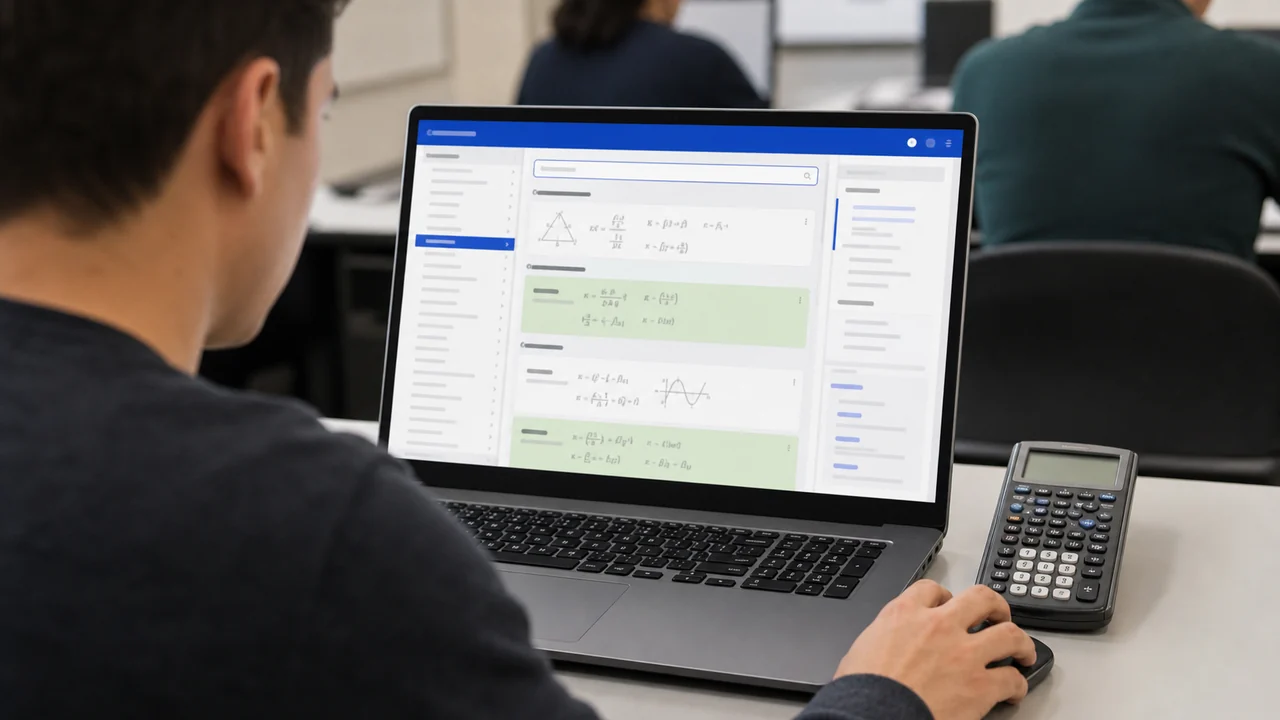
During the FE exam, NCEES provides a digital copy of the FE Reference Handbook on your exam screen. It opens in a split-screen view: the exam question on the left, the handbook on the right. You can resize the split, scroll through pages, and click bookmarks to jump to sections.
The handbook includes formulas, tables, charts, and constants for every FE exam discipline. It does not include worked examples, step-by-step procedures, or conceptual explanations. You get the raw formulas — knowing when and how to apply them is on you.
How Do You Navigate It During the Exam?
The exam software gives you three ways to move through the handbook:
| Method | How It Works | Best For |
|---|---|---|
| Bookmarks panel | Expandable table of contents on the left side of the PDF viewer. Click a section name to jump there. | Jumping to a known section (e.g., “Fluid Mechanics”) |
| Page scrolling | Scroll up/down through pages. Use the scroll bar or mouse wheel. | Browsing within a section you already jumped to |
| Page number entry | Type a page number directly to jump there. | If you have memorized specific page numbers for key formulas |
The fastest approach combines bookmarks and scrolling: click the bookmark to land in the right section, then scroll a page or two to the specific formula. Memorizing exact page numbers works for your 5–10 most-used formulas, but the handbook page numbers can change between versions, so always verify against the current edition.
What Are the Major Sections?
The handbook is organized into shared sections (used by all FE disciplines) and discipline-specific sections. During the exam, you see only the shared sections plus your discipline’s section. Here is the section order:
| Section | What You Will Find | Exam Impact |
|---|---|---|
| Units and Conversions | SI and US customary unit tables, metric prefixes, physical constants | Used on nearly every calculation problem |
| Mathematics | Algebra, trig identities, calculus formulas, differential equations, linear algebra, numerical methods, vectors | Foundation for all disciplines — 6–9 direct questions |
| Probability and Statistics | Distribution formulas, normal distribution table (z-table), combinations/permutations, regression | 4–6 questions; the z-table is used frequently |
| Engineering Economics | Time value of money factors (P/F, A/P, etc.), depreciation formulas, factor tables | 4–6 questions; the factor tables are critical |
| Ethics and Professional Practice | NCEES Model Law, Model Rules, engineering codes of conduct | 4–6 questions; mostly reading comprehension |
| Statics | Equilibrium equations, centroids, moments of inertia, friction | High weight for Civil and Mechanical |
| Dynamics | Kinematics, kinetics, work-energy, impulse-momentum | High weight for Mechanical |
| Mechanics of Materials | Stress/strain, Mohr’s circle, beam deflection tables, column buckling | High weight for Civil, Mechanical, and Structural PE |
| Fluid Mechanics | Bernoulli, Moody diagram, pipe flow, open channel flow, drag | High weight for Civil, Environmental, Mechanical, Chemical |
| Thermodynamics | Laws of thermo, ideal gas, steam tables, refrigeration cycles, psychrometric charts | High weight for Mechanical, Chemical |
| Heat Transfer | Conduction, convection, radiation, heat exchanger formulas, fin equations | Key for Mechanical and Chemical |
| Material Properties | Steel/aluminum/concrete properties, phase diagrams, material selection data | Used across multiple disciplines |
| Electrical and Computer Engineering | Circuit analysis, digital logic, signal processing, power systems, electronics | Primary section for FE ECE exam |
| Discipline-Specific Sections | Civil, Mechanical, Chemical, Environmental — discipline-specific formulas and tables | Only your discipline’s section appears during the exam |
What Is the Fastest Way to Find a Formula?
Speed in the handbook comes from preparation, not exam-day improvisation. Here is a three-step system that works for any discipline:
Step 1: Build a Personal Section Map
Download the free PDF from NCEES and spend one study session just browsing. For each section, write down:
- The section name and starting page number
- The 3–5 formulas you expect to use most
- Anything surprising (formulas in unexpected sections, missing formulas you assumed would be there)
Keep this map next to you during practice sessions. After two weeks of referencing it, you will have the section order memorized.
Step 2: Practice With the Handbook Open
Every time you solve a practice problem, look up the formula in the handbook even if you already know it. This builds muscle memory for where things are. Time yourself: if it takes more than 30 seconds to find a formula, mark that section for extra review.
Step 3: Memorize Your Top 10
There are formulas you will use so often that looking them up wastes time. Memorize these and you will save 5–10 minutes over the full exam:
| Category | Worth Memorizing |
|---|---|
| Unit conversions | 1 ft = 12 in, 1 mile = 5280 ft, 1 hp = 550 ft·lb/s, 1 kW = 1.341 hp, 1 atm = 101.325 kPa |
| Physics basics | F = ma, V = IR (Ohm’s law), P = IV, W = Fd, g = 9.81 m/s² = 32.2 ft/s² |
| Math shortcuts | Quadratic formula, basic derivatives (power rule, chain rule), area/volume of common shapes |
| Your discipline’s core | The 3–5 formulas you use on 50%+ of practice problems (varies by discipline) |
Everything else? Look it up. The handbook is there so you do not have to memorize 500 pages of formulas. Use it.
What Formulas Are Hardest to Find?
Based on common test-taker feedback, these are the formulas and tables that cause the most frustration during the exam:
| Formula / Table | Where Students Look | Where It Actually Is |
|---|---|---|
| Moody diagram | Thermodynamics or Heat Transfer | Fluid Mechanics section |
| Beam deflection tables | Statics | Mechanics of Materials section |
| Normal distribution (z-table) | Mathematics | Probability and Statistics section |
| Engineering economics factor tables | End of Eng. Econ section | Several pages after the factor formulas (easy to scroll past) |
| Steam tables | Fluid Mechanics | Thermodynamics section (near the end) |
| Psychrometric chart | HVAC or Heat Transfer | Thermodynamics section |
What Is NOT in the Handbook?
Knowing what is missing is just as important as knowing what is there. If you expect to look something up and it does not exist, you will waste time searching for it:
- Worked examples — The handbook gives you formulas, not solutions. You need to know how to set up problems yourself.
- Problem-solving procedures — It will not tell you which formula to use for a given problem type. That comes from practice.
- All unit conversions — Common conversions (ft to m, lbs to kg) are there, but obscure combinations are not. Memorize the ones you use most.
- Conceptual definitions — Ethics questions, material property concepts, and engineering terminology are not defined. These are pure knowledge questions.
- Industry codes and standards — The NEC, ACI 318, AISC, AASHTO Green Book, and similar references are not included. Code-based questions on the FE are rare and usually test general principles.
- Calculator instructions — The handbook does not explain how to use your calculator for statistical functions, matrix operations, or equation solving.
How Should You Practice With the Handbook?
The two biggest exam-day regrets test-takers report are “I did not practice with the handbook enough” and “I did not realize the on-screen version was so different from the PDF.” Here is a 4-week practice plan:
| Week | Activity |
|---|---|
| Week 1 | Read the handbook cover-to-cover (skim, do not study). Build your personal section map with page numbers for key formulas. |
| Week 2 | Solve practice problems with the handbook PDF open in split-screen. Time each lookup. Target: under 30 seconds per formula. |
| Week 3 | Take a full timed practice exam using only the handbook for reference (no external notes). Identify sections where you are still slow. |
| Week 4 | Focus drills on your weak sections. Memorize your top 10 formulas. Take one more timed exam to confirm your navigation speed. |
Where Can You Get the Handbook?
- Free PDF: Download the official reference handbook through MyNCEES. This is the version you should use for serious study.
- Printed copy: A printed copy can be useful for marking sections during study, but verify it matches the version assigned to your exam date. You cannot bring a printed handbook into the exam.
- NCEES practice exam: $50 from NCEES — the only official practice exam, and it includes the same on-screen handbook viewer you will see on test day.
What Are the Most Common Handbook Mistakes?
- Never opening it before exam day. Some students study entirely from textbooks and first encounter the handbook during the actual exam. This guarantees slow lookups and panic when formulas are organized differently than expected.
- Trying to memorize everything. The handbook exists so you do not have to. Memorize your top 10 formulas and know where to find the rest. Spending weeks memorizing rarely-used formulas is wasted time.
- Ignoring the shared sections. Mathematics, probability, economics, and ethics appear on every FE exam regardless of discipline. These sections account for 15–25 questions. Students who only study their discipline-specific content leave efficient scoring opportunities on the table.
- Not practicing split-screen navigation. Reading the PDF full-screen on your laptop is not the same as using it in a cramped split-screen viewer while a timer counts down. Practice in split-screen mode.
- Assuming formulas are in obvious sections. The Moody diagram is in Fluid Mechanics, not Thermodynamics. Beam deflection tables are in Mechanics of Materials, not Statics. Steam tables are near the end of Thermodynamics, not the beginning. Learn these locations before exam day.
How Does the Handbook Differ by Discipline?
Every test-taker sees the shared sections (Units, Math, Probability, Economics, Ethics, Statics, Dynamics, Mechanics of Materials, Fluid Mechanics, Thermodynamics, Heat Transfer, Material Properties). Beyond that, you see only your discipline’s section:
| FE Discipline | Additional Sections You See |
|---|---|
| Electrical & Computer | Circuit analysis, electronics, digital systems, signal processing, communications, power systems, electromagnetics |
| Civil | Structural analysis, geotechnical, transportation, environmental, water resources, construction |
| Mechanical | Mechanical design, HVAC, vibrations, control systems, material science, manufacturing |
| Chemical | Mass/energy balances, chemical reaction engineering, process control, process design, safety |
| Environmental | Water/wastewater treatment, air quality, solid/hazardous waste, groundwater, risk assessment |
When studying, focus 60–70% of your handbook practice on your discipline-specific section and 30–40% on the shared sections. The shared sections are where the “easy” points are — math, economics, and ethics formulas that every engineer should know.
🔢 Calculator Guide • ✍️ Practice Problem Strategy • ✅ Exam Day Checklist • 📅 Study Schedules • Free Practice Questions • FE Electrical Study Guide • FE Civil Study Guide • FE Mechanical Study Guide
Frequently Asked Questions
Can you search the FE Reference Handbook during the exam?
The on-screen handbook gives you navigation tools such as bookmarks and section navigation, but you should not rely on browser-style Ctrl+F habits. Practice with the NCEES handbook before exam day so you know where formulas are located and how to reach them quickly.
How many pages is the FE Reference Handbook?
The FE Reference Handbook is roughly 500 pages and covers math, probability, engineering economics, ethics, and discipline-specific formulas. During the exam, you only see sections relevant to your discipline plus the shared sections that all FE exams use. Always verify the version assigned to your exam date in MyNCEES.
Should I memorize formulas or rely on the FE Reference Handbook?
You should memorize high-frequency formulas you will use on 10+ questions (like unit conversions and Ohm’s law) and know where to find everything else in the handbook. The goal is not to memorize the handbook but to navigate it in under 30 seconds for any formula. Students who rely entirely on the handbook without practicing navigation often run out of time.
Where can I download the FE Reference Handbook?
NCEES provides the FE Reference Handbook as a free PDF download through MyNCEES. Always verify the version assigned to your exam date before you study heavily from page numbers, screenshots, or printed notes.
What is NOT in the FE Reference Handbook?
The handbook does not include worked examples, problem-solving procedures, unit conversion tables for every combination, discipline-specific codes or standards (like NEC or ACI), or definitions of conceptual terms. You need to memorize definitions, understand when to apply formulas, and know common unit conversions by heart.
Disclaimer: This guide is based on publicly available information from NCEES. FE Test Prep is not affiliated with or endorsed by NCEES. Always verify handbook version and exam policies at ncees.org before your exam date.
Ready to Practice With the Handbook?
FE Test Prep gives you exam-realistic practice across supported FE and PE disciplines. Solve problems the same way you will on exam day — with a timer, question navigator, and the reference-handbook mindset. Built-in analytics show you exactly which topics need more work.