The FE Civil exam rewards breadth, calm pacing, and quick recognition. You do not need to become a structures, geotech, transportation, water resources, and construction expert all at once; you need to recognize the setup, know where the handbook helps, and keep the calculation moving. This guide gives you the Civil topic map, the highest-return areas to study first, and a 12-week plan built around the way questions actually feel on exam day.
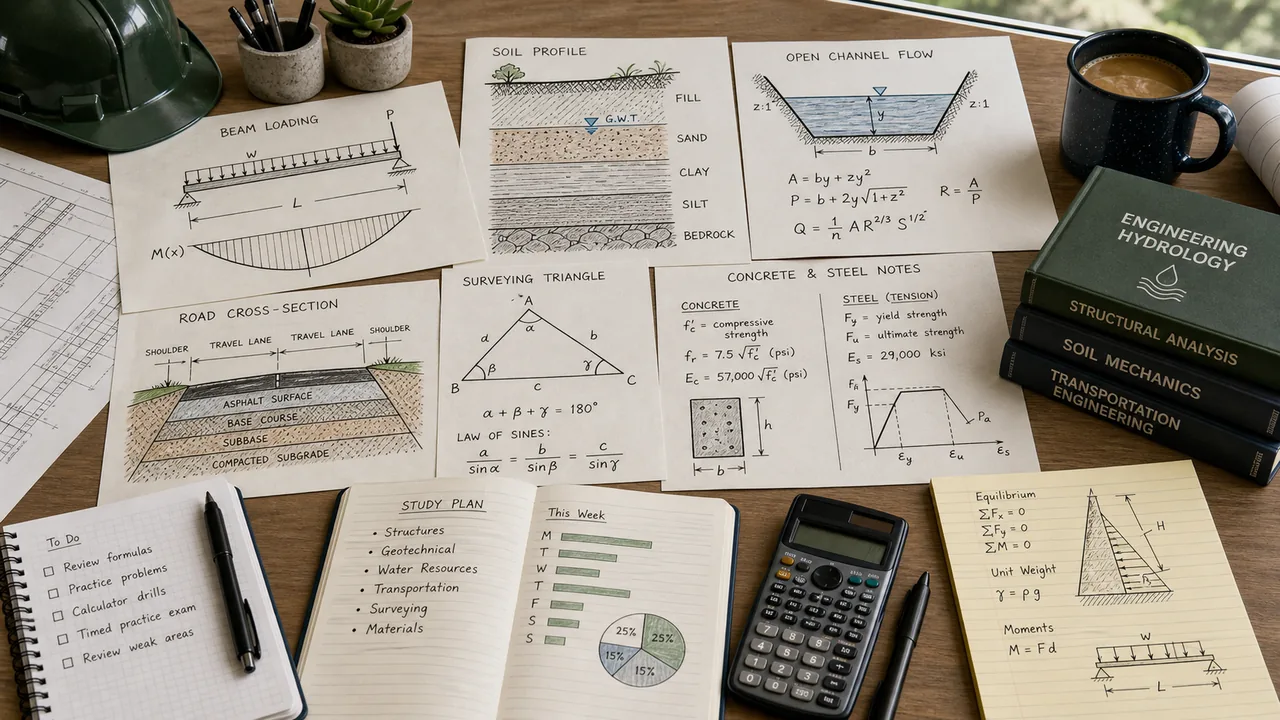
FE Civil Exam at a Glance
| Questions | 110 multiple-choice |
| Time | 5 hours 20 minutes (~2.9 min/question) |
| Format | Computer-based at Pearson VUE centers, year-round |
| Topic areas | 14 knowledge areas |
| Reference | NCEES FE Reference Handbook (provided digitally) |
| Cost | $225 NCEES fee (full cost breakdown) |
| Pass rate | 61% first-time, 32% repeat (NCEES Squared 2025) |
| Result | Engineer Intern (EI) / Engineer in Training (EIT) designation |
What Is the FE Exam and Why Does It Matter?
NCEES administers the computer-based FE exam at Pearson VUE testing centers. You get 110 questions in 5 hours and 20 minutes, plus the digital FE Reference Handbook. Treat that handbook as part of the test, not a backup plan: the faster you can recognize a problem type and jump to the right formula or table, the less pressure every calculation carries.
Passing the FE exam earns you the designation of Engineer Intern (EI) or Engineer in Training (EIT), depending on your state. From there, after accumulating the required years of professional experience (typically four years under a licensed PE), you become eligible to sit for the PE exam and earn full licensure.
Career Benefits of Passing the FE Exam
- PE licensure pathway: A PE license is legally required to sign and seal engineering drawings, offer services directly to the public, and hold certain senior engineering positions. In civil engineering, PE licensure is especially critical—most public infrastructure projects require a licensed PE of record.
- Competitive advantage: Even before you earn your PE, the EIT credential signals competence and commitment to employers. Many civil engineering firms expect new hires to have passed the FE or to pass it within their first year.
- Higher earning potential: Licensed professional engineers consistently earn higher salaries than their unlicensed peers, with many surveys showing a 10–20% premium (Bureau of Labor Statistics).
- Career mobility: Licensure is recognized across all 50 U.S. states and territories through comity agreements, making it easier to work in different jurisdictions.
What Topics Are on the FE Civil Exam?
The FE Civil exam draws from 14 official knowledge areas (a few are split into sub-topics in the breakdown below). NCEES publishes an exam specification that assigns each topic a percentage range, which translates to an approximate number of questions out of 110. Here is the full breakdown:
| Topic Area | Est. Questions | Weight | Priority |
|---|---|---|---|
| Statics | 7–11 | 6–10% | HIGH |
| Mechanics of Materials | 7–11 | 6–10% | HIGH |
| Geotechnical Engineering | 7–11 | 6–10% | HIGH |
| Transportation Engineering | 7–11 | 6–10% | HIGH |
| Structural Analysis | 4–6 | 4–6% | MEDIUM |
| Structural Design | 4–6 | 4–6% | MEDIUM |
| Fluid Mechanics | 4–6 | 4–6% | MEDIUM |
| Hydraulics & Hydrologic Systems | 4–6 | 4–6% | MEDIUM |
| Environmental Engineering | 4–6 | 4–6% | MEDIUM |
| Construction | 4–6 | 4–6% | MEDIUM |
| Surveying | 4–6 | 4–6% | MEDIUM |
| Mathematics | 4–6 | 4–6% | FOUNDATION |
| Probability & Statistics | 4–6 | 4–6% | FOUNDATION |
| Ethics & Professional Practice | 4–6 | 4–6% | FOUNDATION |
| Engineering Economics | 4–6 | 4–6% | FOUNDATION |
| Dynamics | 4–6 | 4–6% | FOUNDATION |
Where to Review the Highest-Return FE Civil Topics
Use this map as a routing table: match the NCEES topic, open the FE Handbook 10.6 page guide, then practice the same lane. External resources are optional refreshers for rusty fundamentals, not replacements for FE-style timed practice.
Draw the free-body diagram before looking for equations.
Most missed civil mechanics problems come from setup, not algebra. Review equilibrium, trusses, shear and moment diagrams, axial stress, bending stress, torsion, and deflection as one connected workflow.
- Handbook move: look up section starts before practice so you know where stress, beam, and section-property tools live.
- Practice move: solve reaction and member-force problems slowly, then repeat under time.
Separate pipe flow, open-channel flow, and runoff problems.
Civil water questions often look similar until you decide whether the governing idea is energy loss, Manning flow, pump power, precipitation, or peak runoff.
- Handbook move: mark the hydraulic, hydrology, and fluid-property lanes you use most.
- Practice move: write the knowns and units before touching the calculator.
Turn soil data into phase relationships and effective stress.
Focus on unit weights, water content, void ratio, effective stress, consolidation, compaction, permeability, and shallow foundation patterns.
- Handbook move: learn the soil-property cluster as a lookup area, not isolated formulas.
- Practice move: redraw phase diagrams whenever a problem mixes volume, weight, and water terms.
Memorize the decision points, not every transportation equation.
Transportation problems usually ask you to recognize the right lane: traffic flow, horizontal/vertical curves, stopping sight distance, capacity, or signal timing.
- Handbook move: group transportation formulas by road geometry, flow, and control.
- Practice move: check whether the question is asking for design, operations, or safety before calculating.
Use foundation topics to protect efficient scoring opportunities.
Civil candidates often under-study the shared topics because they feel less technical. Keep probability distributions, regression, present worth, annual worth, and ethics in your weekly rotation.
- Handbook move: know where tables, distributions, and economic factors start.
- Practice move: treat calculator setup errors as a separate review category.
Source note: topic names and question ranges should be checked against the current NCEES FE exam page. External resources are optional review aids and may include material outside the FE exam scope.
Below is a detailed look at each topic area and what to expect.
1. Mathematics (4–6 questions)
Covers calculus (derivatives and integrals), differential equations, linear algebra, and analytic geometry. You will encounter problems involving vector operations, partial derivatives, and solving first- and second-order differential equations. The NCEES FE Reference Handbook provides key formulas, but you need to know how to recognize which technique applies and execute it quickly. Do not overlook this section—math underpins nearly every other topic on the exam.
Key concepts to master:
- Derivatives, integrals (substitution, integration by parts), and limits
- First- and second-order ordinary differential equations
- Matrix operations, eigenvalues, and solving linear systems
2. Probability and Statistics (4–6 questions)
Expect questions on probability distributions (normal, binomial, Poisson), measures of central tendency and dispersion, linear regression, hypothesis testing, and confidence intervals. Civil engineers use statistics extensively in areas like quality control, hydrology, and traffic analysis, so these concepts will reappear throughout the exam in applied form. Most problems are straightforward if you understand when to apply each distribution.
Key concepts to master:
- Mean, median, standard deviation, and variance from a data set
- Normal, binomial, and Poisson distributions—and when to apply each
- Confidence intervals, hypothesis testing (Z-test, t-test), and linear regression
3. Ethics and Professional Practice (4–6 questions)
Covers the NCEES Model Rules of Professional Conduct, ethical obligations, public safety considerations, and licensure requirements. These are conceptual rather than computational—you will be given scenarios and asked to identify the correct ethical course of action. Read the ethics section in the reference handbook carefully.
Key concepts to master:
- NCEES Model Rules and the engineer’s duty to protect public welfare
- Conflict of interest, gifts, competitive bidding, and signing/sealing authority
- Licensure path: education, experience under a PE, and the PE exam
4. Engineering Economics (4–6 questions)
Topics include time value of money, present and future worth analysis, annual cost comparisons, benefit-cost analysis, rate of return, breakeven analysis, and depreciation methods. Master the standard factor formulas (P/F, F/P, A/P, A/F, P/A, F/A) and you will handle these efficiently. Civil engineers routinely use economic analysis to compare design alternatives, so expect questions framed around infrastructure project decisions.
Key concepts to master:
- Time-value factor formulas: P/F, F/P, A/P, A/F, P/A, F/A
- Present worth, annual cost, benefit-cost ratio, and rate of return
- Straight-line, declining-balance, and MACRS depreciation
5. Statics (7–11 questions)
One of the most heavily tested topics on the exam. Covers resultants of force systems, concurrent and non-concurrent forces, equilibrium of rigid bodies, analysis of trusses (method of joints and method of sections), frames and machines, centroids and moments of inertia, and friction. You must be able to draw free body diagrams confidently and solve equilibrium equations.
Key concepts to master:
- 2D and 3D equilibrium: ΣF = 0 and ΣM = 0
- Truss analysis by method of joints and method of sections
- Centroids, moments of inertia, and static/kinetic friction
6. Dynamics (4–6 questions)
Covers kinematics of particles and rigid bodies, kinetics using Newton's second law, work-energy methods, impulse-momentum methods, and introductory vibrations. Expect problems involving projectile motion, rotating bodies, and conservation of energy or momentum. While dynamics carries fewer questions than statics, the problems can be time-consuming, so practice solving them efficiently.
Key concepts to master:
- Kinematics: projectile motion, rotating bodies, and curvilinear motion
- Newton’s second law, work-energy, and impulse-momentum methods
- Simple harmonic motion and natural frequency of a single-DOF system
7. Mechanics of Materials (7–11 questions)
Another high-weight topic. Includes stress and strain (normal and shear), axial loading, torsion of circular shafts, bending stresses in beams, shear stresses in beams, combined loading, Mohr’s circle for stress and strain, beam deflections, statically indeterminate members, and column buckling (Euler’s formula). You should be comfortable computing stresses, drawing shear and moment diagrams, and applying failure criteria. This topic connects directly to structural analysis and design.
Key concepts to master:
- Normal, shear, and bearing stress; strain and Hooke’s law
- Shear and moment diagrams; flexural stress σ = Mc/I
- Torsion τ = Tc/J, Mohr’s circle, and Euler column buckling
8. Fluid Mechanics (4–6 questions)
Covers fluid properties (density, viscosity, surface tension), fluid statics and manometry, buoyancy, the Bernoulli equation, the continuity equation, pipe flow with friction losses (Darcy-Weisbach and Moody diagram), Reynolds number, and dimensional analysis. Know how to identify laminar versus turbulent flow and how to use the energy equation for pipe systems. Fluid mechanics provides the foundation for the hydraulics and hydrology section that follows.
Key concepts to master:
- Hydrostatic pressure, buoyancy, and manometer equations
- Continuity, Bernoulli, and energy equations for incompressible flow
- Reynolds number, Darcy-Weisbach friction losses, and the Moody diagram
9. Hydraulics and Hydrologic Systems (4–6 questions)
Focuses on open-channel flow (Manning’s equation, critical flow, hydraulic jump), the rational method for storm runoff estimation, rainfall-runoff relationships, unit hydrographs, pump system curves, and reservoir routing. Expect problems where you calculate flow rates in channels, size culverts, or determine peak discharge from a drainage basin. Have Manning’s equation and the rational method formula committed to quick recall.
Key concepts to master:
- Manning’s equation for open-channel flow; critical and normal depth
- Rational method Q = CiA for peak runoff estimation
- Pump system curves, pipe networks, and reservoir routing
10. Structural Analysis (4–6 questions)
Covers static determinacy and stability, analysis of statically determinate beams, frames, and trusses, shear and moment diagrams, influence lines for determinate structures, deflection methods (virtual work, conjugate beam), and introductory concepts of indeterminate analysis. You should be able to quickly assess whether a structure is stable and determinate, and then compute internal forces and deflections.
Key concepts to master:
- Static determinacy and stability of beams, trusses, and frames
- Shear and moment diagrams for determinate beams
- Beam deflection by virtual work, conjugate beam, or superposition
11. Structural Design (4–6 questions)
Introduces design provisions from the major codes: ACI 318 for reinforced concrete (flexural and shear design of beams, one-way slabs), AISC 360 for structural steel (tension members, compression members, beam design), and NDS for timber design. You will also encounter load combinations from ASCE 7 (LRFD and ASD). Know the basic design equations and how to apply strength reduction factors. You do not need to memorize code tables—relevant values are provided in the reference handbook.
Key concepts to master:
- ACI 318 flexural and shear design of reinforced concrete beams
- AISC 360 steel tension members, compression members, and beams
- ASCE 7 load combinations (LRFD and ASD) and strength-reduction factors
12. Geotechnical Engineering (7–11 questions)
A major topic area. Covers soil classification (USCS and AASHTO), phase relationships (void ratio, porosity, degree of saturation, unit weight), compaction, effective stress and pore water pressure, permeability and seepage, consolidation and settlement, shear strength (Mohr-Coulomb), bearing capacity, lateral earth pressure (Rankine and Coulomb), and retaining wall stability. Many problems require you to work through multi-step calculations involving soil properties.
Key concepts to master:
- Phase relationships: void ratio, porosity, saturation, and unit weights
- Effective stress, 1-D consolidation (Terzaghi), and settlement
- Mohr-Coulomb shear strength, bearing capacity, and lateral earth pressure
13. Transportation Engineering (7–11 questions)
Another heavily tested topic. Covers geometric design of highways (horizontal and vertical curves, superelevation, sight distance), traffic engineering (level of service, capacity, signal timing, speed-density-flow relationships), pavement design (flexible and rigid), and accident analysis. Expect problems that require you to compute stopping sight distance, design a vertical curve for a given design speed, or determine the level of service for a highway segment. Become comfortable with the AASHTO Green Book concepts covered in the reference handbook.
Key concepts to master:
- Horizontal curves (radius, superelevation) and crest/sag vertical curves
- Stopping sight distance and passing sight distance calculations
- Speed-density-flow relationships, level of service, and signal timing
14. Environmental Engineering (4–6 questions)
Covers water and wastewater treatment processes, biochemical oxygen demand (BOD) and dissolved oxygen (DO) modeling, mass balance and reactor kinetics, air quality basics, solid waste management, and environmental regulations. Know how to perform a BOD removal calculation, size a sedimentation basin, and apply the Streeter-Phelps oxygen sag equation. These problems tend to be formula-driven and very manageable with practice.
Key concepts to master:
- BOD removal, DO sag, and the Streeter-Phelps equation
- Mass balance and reactor kinetics (CSTR, PFR, first-order decay)
- Sedimentation, coagulation, disinfection, and drinking-water standards
15. Construction (4–6 questions)
Covers Critical Path Method (CPM) scheduling, project planning (activity-on-node networks, float calculations), construction cost estimating, temporary structures and safety, procurement and delivery methods, and construction contracts. CPM problems are among the most commonly tested—practice identifying the critical path, computing early/late start and finish times, and determining total and free float for activities.
Key concepts to master:
- CPM scheduling: early/late start and finish, total float, free float
- Identifying the critical path and crashing activities to compress schedules
- Cost estimating, earned-value analysis, and delivery methods (DBB, DB, CMAR)
16. Surveying (4–6 questions)
Covers differential leveling, traverse computations (latitudes and departures, closure corrections), area calculations (coordinate method, DMD method), horizontal and vertical curves, and fundamentals of GPS/GNSS. Expect problems where you compute elevation differences from level notes, adjust a closed traverse, or calculate the area of an irregular parcel. Surveying problems are highly procedural—once you know the steps, they are reliable point-earners.
Key concepts to master:
- Differential leveling and elevation computations
- Traverse adjustment: latitudes, departures, and closure corrections
- Area by coordinate method and fundamentals of GPS/GNSS
Which Topics Should You Prioritize?
Not every topic carries equal weight. A strategic study plan focuses your limited time where it will earn the most points.
The Big Four (28–44 questions, ~25–40% of the exam)
- Statics — the foundational topic that everything structural builds upon
- Mechanics of Materials — heavily tested, formula-driven, and directly connected to statics
- Geotechnical Engineering — high volume with multi-step problems that reward thorough preparation
- Transportation Engineering — another high-count area with very learnable, procedural calculations
If you can consistently answer these four topic areas correctly, you are well on your way to passing.
After mastering those, move to the mid-weight topics: Structural Analysis, Structural Design, Fluid Mechanics, Hydraulics and Hydrologic Systems, Environmental Engineering, Construction, and Surveying. These collectively represent another 28–42 questions (roughly 25–38% of the exam). Many of these are formula-driven and very learnable in a short time.
Finally, review the foundational topics: Mathematics, Probability and Statistics, Ethics and Professional Practice, Engineering Economics, and Dynamics. While they carry fewer questions individually (4–6 each), together they still account for roughly 20–30 questions. Ethics and Engineering Economics in particular offer a strong return on a small time investment.
Worked Examples: One Problem from Each Big Four Topic
Here are four short worked examples—one from each of the highest-weight topic areas. Each problem is at the difficulty level of an actual FE Civil exam item. Try solving each one on paper before reading the solution.
Example 1 — Statics: Cable Tension on a Hinged Bar
Problem: A uniform horizontal bar is pinned at end A and supported by a cable at end B. The bar is 4 m long and the cable makes a 30° angle with the bar. A 500 N vertical load hangs from the midpoint of the bar. Neglecting the bar’s weight, what is the tension in the cable?
Solution: Take moments about the pin A to eliminate the pin reactions. Only the cable tension T and the 500 N load contribute.
ΣMA = 0: T·sin(30°)·(4 m) − (500 N)(2 m) = 0
T = 1000 / (4 · 0.5) = 500 N
Why it matters: Moment equilibrium is the single most reusable tool in FE Civil Statics. If you can pick a smart pivot point, most two-unknown problems collapse to a one-line calculation.
Example 2 — Mechanics of Materials: Torsion in a Solid Shaft
Problem: A solid circular steel shaft has a diameter of 50 mm and transmits a torque of 800 N·m. What is the maximum shear stress in the shaft?
Solution: For a solid circular shaft, τmax = Tc / J, where c = d/2 and J = πd4/32.
c = 0.025 m
J = π(0.050)4/32 = 6.14 × 10⁻⁷ m4
τmax = (800)(0.025) / (6.14 × 10⁻⁷) ≈ 32.6 MPa
Why it matters: The torsion formula is one of the handbook’s most formulaic relationships. Memorize the polar moment J for solid and hollow circular shafts and these problems become plug-and-chug.
Example 3 — Geotechnical: Effective Vertical Stress
Problem: A soil deposit has a moist unit weight of 18 kN/m3 above the water table and a saturated unit weight of 20 kN/m3 below. The water table is 2 m below the ground surface. What is the effective vertical stress at a depth of 6 m? Use γw = 9.81 kN/m3.
Solution: Compute total stress, pore water pressure, and effective stress (σ′ = σ − u).
σ = (18)(2) + (20)(4) = 36 + 80 = 116 kPa
u = (9.81)(4) = 39.24 kPa
σ′ = 116 − 39.24 ≈ 76.8 kPa
Why it matters: Effective stress drives consolidation, shear strength, and bearing capacity. Getting this step right is prerequisite to almost every other geotechnical problem.
Example 4 — Transportation: Minimum Radius of a Horizontal Curve
Problem: Determine the minimum radius of a horizontal circular curve for a design speed of 60 mph, superelevation rate e = 0.08, and side friction factor f = 0.12.
Solution: Using the standard AASHTO formula R = V2 / [15(e + f)] with V in mph and R in feet:
R = (60)2 / [15(0.08 + 0.12)]
R = 3600 / (15 · 0.20) = 3600 / 3 = 1200 ft
Why it matters: Horizontal-curve problems are almost always a direct plug into one of three formulas (minimum radius, superelevation, stopping sight distance on curves). Recognizing which one applies is usually the whole battle.
For 10 more fully worked problems across every FE Civil topic, see our FE Civil practice problems with step-by-step solutions.
How Should You Structure Your 12-Week Study Plan?
A realistic FE Civil plan often budgets 200–300 hours over 8 to 16 weeks. Here is a week-by-week plan tailored to the FE Civil exam:
| Weeks | Focus Areas | What to Do |
|---|---|---|
| 1–2 | Math, Probability & Stats, Engineering Economics | Take a diagnostic exam to identify weak areas. Review these foundational topics to warm up problem-solving skills and build early confidence. |
| 3–4 | Statics, Dynamics | Focus on free body diagrams, equilibrium, truss analysis, kinematics, and energy methods. Drill until these feel automatic. |
| 5–6 | Mechanics of Materials, Structural Analysis & Design | Work through stress/strain, beam bending, Mohr’s circle, column buckling, shear and moment diagrams, and basic ACI/AISC/NDS design. |
| 7–8 | Geotechnical Engineering, Fluid Mechanics | Practice phase relationships, effective stress, consolidation, shear strength, bearing capacity, pipe flow, and Bernoulli equation problems. |
| 9–10 | Transportation, Hydraulics, Environmental | Focus on highway curves, traffic analysis, Manning’s equation, the rational method, BOD/DO problems, and treatment calculations. |
| 11–12 | Construction, Surveying, Ethics + Full Practice Exams | Practice CPM scheduling, leveling, traverse adjustments. Take 2+ full-length timed practice exams. Review every missed question. |
What Study Tips Will Help You Pass?
- Practice under timed conditions: You have roughly 2.9 minutes per question. Build your pacing instincts by taking full practice exams with a timer. If a problem is taking too long, flag it and move on—you can return to flagged questions later.
- Do not leave questions blank: There is no penalty for guessing. If you are stuck, eliminate what you can, choose an answer, flag it, and move on. An educated guess is always better than a blank response.
- Focus on units and reasonableness: Civil engineering problems frequently involve unit conversions (feet to meters, psi to kPa, cfs to gpm). Carry your units through every calculation to catch errors. If your answer has unreasonable units or magnitude, recheck your work before moving on.
Test-Day Strategy and Common Mistakes
A study plan wins points before exam day; execution protects them on it. FE Civil was 61% first-time pass / 32% repeat in the NCEES Squared 2025 table, and the gap between passing and not often comes down to pacing and avoidable errors rather than knowledge. Here is how to keep the points you prepared for.
What to do on test day
- Arrive early. Pearson VUE centers require check-in with valid, unexpired ID. Give yourself at least 30 minutes before your appointment to get through check-in and settle in.
- Manage time aggressively. With 110 questions in 320 minutes you have under 3 minutes each. If a problem will clearly take more than 4 minutes, flag it and move on, then return with whatever time remains.
- Answer every question. There is no penalty for wrong answers, so a blank is a guaranteed zero while a guess on four options is a 25% chance. Always select something.
- Collect setup-driven points first. Free-body diagrams, soil classification, transportation tables, and fluids problems often reveal their method quickly. Work those before sinking time into a multi-step structural or geotechnical calculation.
- Use the break to reset. Civil problems depend on clean diagrams — slopes, shear and moment signs, drainage areas, soil layers, traffic movements. A few minutes away from the screen keeps you from carrying the last sketch into the next problem.
- When a subtopic is unfamiliar, search by object. If the formula name will not come to mind, search the handbook for the thing in the problem: culvert, consolidation, Manning, stopping sight distance, or retaining wall.
The most common mistakes to avoid
- Spending too long on one question. The single most common reason people run out of time. If you have been on a question more than four minutes, flag it and move on.
- Ignoring low-weight topics entirely. Ethics, Economics, Surveying, and Environmental are often the easiest points to earn with light prep, and together can account for 16–24 questions.
- Not practicing with the reference handbook. If you never open the handbook until exam day, you will waste minutes hunting for formulas. Make it your primary reference during every practice session.
- Memorizing instead of understanding. The exam tests application to unfamiliar problems. Understand when and why a method applies — especially in geotechnical and structural design — rather than memorizing formulas.
- Neglecting calculator proficiency. Your approved calculator solves systems, finds roots, and runs statistics. Doing those by hand on exam day costs time and accuracy.
- Cramming the night before. Last-minute cramming raises anxiety and cuts sleep, both of which hurt performance. Do a light review at most, then rest.
- Leaving questions blank. There is no penalty for guessing. Always select an answer before moving on.
What Study Materials Do You Need?
The right resources make a significant difference in your preparation. Here are the essentials:
- NCEES FE Reference Handbook — The exact reference you will use during the exam. Study with it daily so you know where every formula lives.
- NCEES FE Civil Practice Exam — The only official practice exam. Take it under timed conditions as your final readiness check.
- Lindeburg FE Civil Review Manual — A broad review book covering the major Civil exam areas with practice problems and detailed explanations.
For a full comparison of prep books, calculators, and other resources, see our best FE exam prep books guide and exam day checklist.
Final Thoughts
The FE Civil Engineering exam is challenging, but it is absolutely passable with a structured study plan and consistent effort. Focus on the high-weight topics first—Statics, Mechanics of Materials, Geotechnical Engineering, and Transportation Engineering—then build outward to the remaining areas. Become fluent with the reference handbook, take plenty of practice exams under realistic conditions, and manage your time carefully on exam day. Every hour you invest in preparation brings you one step closer to your PE license and the career opportunities that come with it.
How to Pass the FE Civil Exam • FE Civil Practice Problems • Best FE Exam Prep Books • 🔢 Calculator Guide • ✅ Exam Day Checklist • Guide for Returning Engineers
Frequently Asked Questions
How many questions are on the FE Civil exam?
The FE Civil exam has 110 multiple-choice questions. You have 5 hours and 20 minutes to complete it, which works out to about 2.9 minutes per question. The exam is computer-based and offered year-round at Pearson VUE testing centers.
What topics are on the FE Civil exam?
The FE Civil exam covers a broad mix of civil and shared engineering topics. The four highest-weight topics are Statics, Mechanics of Materials, Geotechnical Engineering, and Transportation Engineering, each carrying 7–11 questions. Together these four areas account for roughly 25–40% of the exam.
How long should I study for the FE Civil exam?
A realistic FE Civil plan often budgets 200–300 hours over 8 to 16 weeks. A 12-week study plan is a practical timeframe for many candidates. Start with high-weight topics like Statics and Geotechnical Engineering, then work through mid-weight and foundational areas.
What calculator can I use on the FE exam?
Only NCEES-approved calculators are allowed. The most popular choices are the TI-36X Pro and the Casio fx-115ES PLUS. The proctor will inspect your calculator before you enter the testing room. If your calculator is not on the approved list, you take the exam without one.
Is the FE Reference Handbook provided during the exam?
Yes. NCEES provides a searchable digital copy of the FE Reference Handbook on your exam computer. You cannot bring your own notes or reference materials. Practicing with the handbook during your study sessions is essential so you can find formulas quickly on exam day.
Can I use the TI-36X Pro on the FE Civil exam?
Yes. The TI-36X Pro is on the official NCEES approved calculator list and is the most popular choice among FE Civil candidates. Its equation solver, numerical integration, and statistical functions cover essentially every calculation you will need. The Casio fx-115ES PLUS (or fx-115ES PLUS 2nd edition) is an equally approved alternative. See our FE exam calculator guide for a full breakdown.
Is the FE Civil exam harder than FE Mechanical or FE Electrical?
Difficulty is highly personal and depends on your coursework. NCEES publishes discipline-by-discipline pass rates that are broadly similar, typically in the 60–75% range for first-time takers from ABET-accredited programs. FE Civil has the same number of topic areas as FE Mechanical (14 each, vs. 17 for Electrical) but fewer deeply computational areas than FE Mechanical. Most candidates find the exam they prepared for in their major the easiest.
What score do I need to pass the FE Civil exam?
NCEES does not publish a fixed passing percentage. The exam is scored using a psychometric cut score set by a committee of licensed professional engineers, and the score is scaled. You will leave the testing center with only a pass/fail result—no numeric score. Consistently answering roughly 70% of mixed practice problems is a useful readiness signal, not an official passing threshold.
How many times can I retake the FE Civil exam?
NCEES allows up to three attempts within any 12-month period, with a minimum two-month wait between attempts. There is no lifetime cap on attempts. If you do not pass on your first try, use the diagnostic report NCEES provides to focus your next study cycle on the weakest topic areas.
When should I take the FE Civil exam?
The best time is your senior year of an ABET-accredited civil engineering program or within one year of graduation. That is when coursework material is freshest in your memory. If you are already working, plan to study 8–16 weeks before you sit for the exam. The FE is offered year-round, so pick a date that gives you enough lead time for 200–300 hours of preparation.
Is the FE Civil exam worth it if I don’t plan to become a PE?
Yes, for most civil engineers. Passing earns you the Engineer Intern (EI) or Engineer in Training (EIT) designation, which is recognized by employers as proof of baseline technical competence. It also keeps the PE path open, which you may want later—most civil engineers who reach senior design or project roles eventually need a PE license. The FE also transfers well across states and is simpler to pass right after graduation than years later.
Disclaimer: This guide is an independent educational resource and is not affiliated with, endorsed by, or sponsored by NCEES. The “Fundamentals of Engineering” exam, “FE” exam, and “NCEES” are trademarks of the National Council of Examiners for Engineering and Surveying. Exam specifications and content are subject to change; always refer to the official NCEES website for the most current information.
Ready to Start Practicing?
Practice the Civil workflow: identify the topic, find the right formula or table, run the calculation cleanly, and review the miss. FE Test Prep pairs Civil questions with step-by-step solutions, key signals, Quick Formula Reference support, and calculator help so each session teaches the next rep.
Start the free FE Civil diagnostic
Enter your email for FE Civil study updates, then jump into the free 20-question diagnostic. No account needed.