The FE Electrical and Computer exam rewards fast pattern recognition. A circuit problem, power problem, signal problem, or digital logic problem usually gives away its path if you know what to look for. This guide gives you the topic map, the high-return study order, worked examples, and a 12-week plan that keeps your practice focused on the questions most likely to move your score.
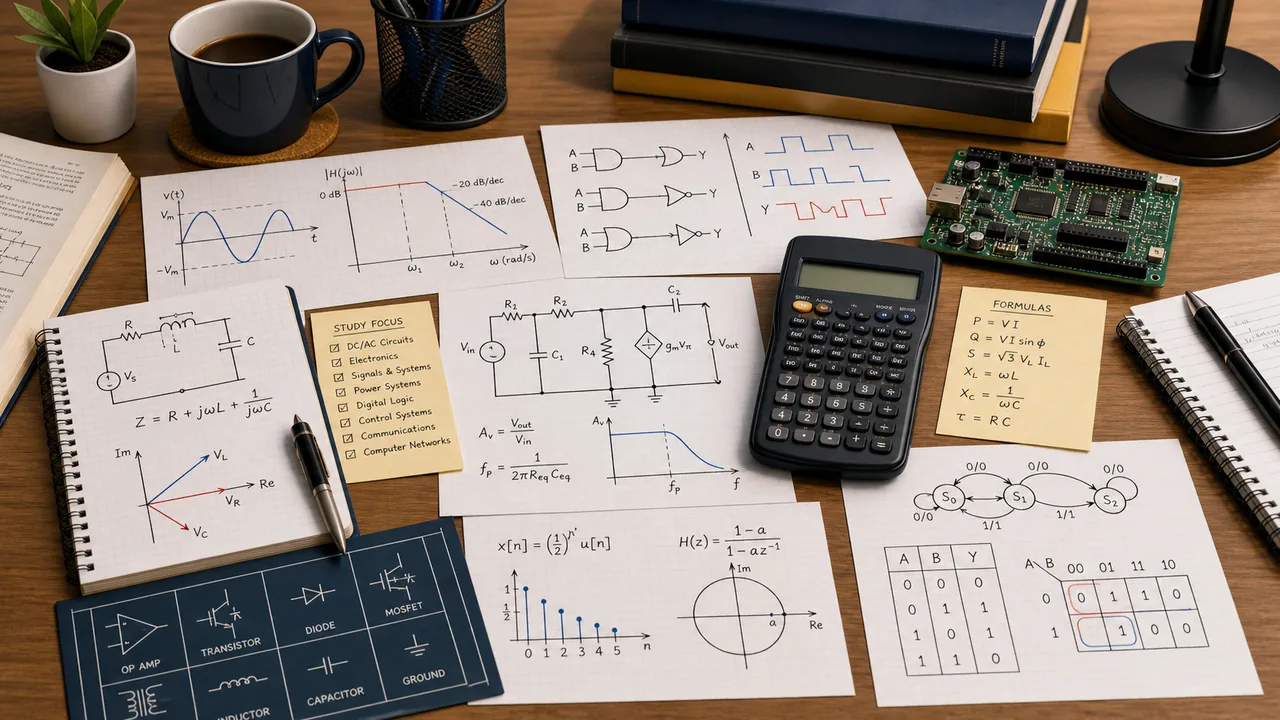
FE Electrical Exam at a Glance
- 64% first-time / 31% repeat pass rate (NCEES Squared 2025)
- $225 NCEES fee — see the full cost breakdown
- 110 questions in 5 hours 20 minutes (computer-based, year-round)
- 17 topic areas — Circuit Analysis is the highest-weight single topic
- Big 4 topics (Circuits, Electronics, Signals, Digital) account for ~20–33% of the exam
- NCEES provides the FE Reference Handbook digitally — no outside notes allowed
- A realistic plan often budgets 200–300 hours over 8–16 weeks
What Is the FE Exam and Why Does It Matter?
NCEES administers the computer-based FE exam at Pearson VUE testing centers. You get 110 questions in 5 hours and 20 minutes, plus the digital FE Reference Handbook. Treat the handbook as part of your workflow: recognize the topic, jump to the right equation or table, then use the calculator cleanly enough that arithmetic does not steal the point.
Passing the FE exam earns you the designation of Engineer Intern (EI) or Engineer in Training (EIT), depending on your state. From there, after accumulating the required years of professional experience (typically four years under a licensed PE), you become eligible to sit for the PE exam and earn full licensure.
Career Benefits of Passing the FE Exam
- PE licensure pathway: A PE license is legally required to sign and seal engineering drawings, offer services directly to the public, and hold certain senior engineering positions.
- Competitive advantage: Even before you earn your PE, the EIT credential signals competence and commitment to employers.
- Higher earning potential: Licensed professional engineers consistently earn higher salaries than their unlicensed peers, with many surveys showing a 10–20% premium (Bureau of Labor Statistics).
- Career mobility: Licensure is recognized across all 50 U.S. states and territories through comity agreements, making it easier to work in different jurisdictions.
What Are the 17 Topic Areas on the FE Electrical Exam?
The FE Electrical and Computer Engineering exam draws from 17 distinct knowledge areas. NCEES publishes an exam specification that assigns each topic a percentage range, which translates to an approximate number of questions out of 110. Below is each topic area with its estimated question count and what to expect.
| Topic Area | Est. Questions | Weight | Priority |
|---|---|---|---|
| Digital Systems | 9–14 | 8–13% | HIGH |
| Electronics | 7–11 | 6–10% | HIGH |
| Mathematics | 6–9 | 5–8% | HIGH |
| Probability & Statistics | 4–6 | 4–5% | HIGH |
| Ethics & Professional Practice | 4–6 | 4–5% | HIGH |
| Engineering Economics | 4–6 | 4–5% | MEDIUM |
| Properties of Electrical Materials | 4–6 | 4–5% | MEDIUM |
| Computer Networks | 4–6 | 4–5% | MEDIUM |
| Signal Processing | 4–6 | 4–5% | MEDIUM |
| Communications | 4–6 | 4–5% | MEDIUM |
| Software Engineering | 3–5 | 3–5% | MEDIUM |
| Power Systems | 3–5 | 3–5% | MEDIUM |
| Electromagnetics | 3–5 | 3–5% | LOW |
| Circuit Analysis | 3–5 | 3–5% | LOW |
| Linear Systems | 3–5 | 3–5% | LOW |
| Instrumentation | 2–4 | 2–4% | LOW |
| Computer Systems | 2–4 | 2–4% | LOW |
Where to Review the Highest-Return FE Electrical and Computer Topics
Use this map to turn the long topic list into a study path. Start with the handbook lanes you will use on exam day, then use the external refreshers only when a concept is weak enough to slow your practice.
Practice phasors, impedance, and three-phase work together.
Do not split circuits and power too far apart. AC circuit setup, complex arithmetic, real/reactive power, transformers, and three-phase relationships reinforce each other.
- Handbook move: mark the circuit, AC power, and conversion sections before timed sets.
- Practice move: write magnitudes, angles, and units explicitly to avoid calculator-mode mistakes.
Know the behavior before hunting for device equations.
Diodes, BJTs, MOSFETs, op-amps, filters, and small-signal assumptions reward pattern recognition. Start by predicting the operating region or ideal op-amp rule.
- Handbook move: group device models and op-amp relationships by circuit type.
- Practice move: annotate polarity and current direction before solving.
Turn logic questions into tables, states, or binary arithmetic.
Boolean algebra, logic gates, flip-flops, counters, number systems, memory, and computer architecture become easier when you force a structured representation.
- Handbook move: keep digital logic and computer-system references separate in your notes.
- Practice move: redraw state or truth tables even when the question feels simple.
Connect Laplace, transfer functions, and frequency response.
Signals and controls problems are often lookup-friendly if you know whether the task is transform, block-diagram algebra, stability, or Bode interpretation.
- Handbook move: learn where transforms, system response, and controls tables begin.
- Practice move: label input, output, and transfer function before simplifying.
Protect the shared-topic points that do not require EE depth.
Complex numbers, matrices, probability distributions, expected value, and engineering economics appear alongside technical topics. They are good recovery points on a hard exam.
- Handbook move: mark math identities, probability tables, and economic factors.
- Practice move: build calculator fluency for complex numbers and distributions.
Source note: topic names and question ranges should be checked against the current NCEES FE exam page. External resources are optional review aids and may include material outside the FE exam scope.
Below is a detailed look at each topic area and what to expect.
1. Mathematics (6–9 questions)
Covers analytic geometry, calculus, differential equations, linear algebra, complex numbers, and discrete mathematics. You will need to solve integrals, work with matrices, and apply Euler's formula. The NCEES FE Reference Handbook includes key formulas, but you need to know how to apply them quickly.
Key concepts to master:
- Complex numbers: rectangular/polar conversion and Euler’s formula
- Derivatives, integrals, and first/second-order ODEs
- Matrix operations, determinants, eigenvalues, and Boolean/discrete math
2. Probability and Statistics (4–6 questions)
Expect questions on probability distributions (normal, binomial, Poisson), measures of central tendency, regression analysis, hypothesis testing, and expected values. Many of these problems are straightforward if you understand the underlying distributions.
Key concepts to master:
- Normal, binomial, and Poisson distributions—and when to apply each
- Mean, variance, standard deviation, and expected value
- Linear regression and basic hypothesis testing
3. Ethics and Professional Practice (3–5 questions)
Covers the NCEES Model Rules of Professional Conduct, ethical obligations, public safety considerations, and licensure requirements. These are conceptual rather than computational—read the ethics section in the reference handbook carefully because focused review can turn this into a reliable scoring area.
Key concepts to master:
- NCEES Model Rules and duty to protect public health, safety, and welfare
- Conflicts of interest, gifts, and competitive bidding rules
- Licensure requirements and signing/sealing authority
4. Engineering Economics (3–5 questions)
Topics include time value of money, present and future worth analysis, annual cost comparisons, benefit-cost analysis, rate of return, and depreciation. Master the standard factor formulas (P/F, F/P, A/P, etc.) and you will handle these efficiently.
Key concepts to master:
- Time-value factors: P/F, F/P, A/P, A/F, P/A, F/A
- Present worth, annual cost, and rate of return comparisons
- Straight-line and declining-balance depreciation
5. Properties of Electrical Materials (3–5 questions)
Focuses on conductivity, resistivity, dielectric properties, magnetic permeability, and semiconductor physics. Understand the differences between conductors, insulators, and semiconductors, along with basic material behavior under varying conditions.
Key concepts to master:
- Resistivity, conductivity, and temperature coefficients of resistance
- Dielectric constant, breakdown strength, and magnetic permeability
- Semiconductor basics: doping, p-n junctions, and intrinsic vs. extrinsic materials
6. Engineering Sciences (4–6 questions)
A broad category covering work, energy, power, charge, forces, and basic mechanics relevant to electrical systems. Think of it as applied physics—conservation of energy, electrostatics, and basic thermodynamic concepts may all appear.
Key concepts to master:
- Work, energy, and power conservation in mechanical and electrical systems
- Coulomb’s law, electric fields, and electrostatic energy
- Basic thermodynamics (1st law) and heat transfer concepts
7. Circuit Analysis (8–12 questions)
One of the heaviest topics on the exam. Covers DC and AC circuit analysis, Kirchhoff's laws, Thevenin and Norton equivalents, node and mesh analysis, impedance, phasors, power factor, and transient response of RL, RC, and RLC circuits. This is a must-master category.
Key concepts to master:
- KVL/KCL, node and mesh analysis, superposition
- Thevenin/Norton equivalents and maximum power transfer
- Phasor analysis of RLC circuits, impedance, and power factor
8. Linear Systems (5–8 questions)
Focuses on Laplace transforms, transfer functions, impulse and step responses, convolution, and system stability. Understanding how to move between time-domain and frequency-domain representations is essential.
Key concepts to master:
- Laplace transforms and inverse Laplace transforms
- Transfer functions, poles, zeros, and BIBO stability
- Impulse response, step response, and convolution
9. Signal Processing (5–8 questions)
Covers Fourier series and transforms, sampling theory (Nyquist), discrete-time signals, z-transforms, and basic filter design (low-pass, high-pass, band-pass). Know Shannon's sampling theorem and how aliasing occurs.
Key concepts to master:
- Fourier series and Fourier transforms of common signals
- Nyquist sampling theorem and aliasing
- Z-transforms and digital filter basics (FIR/IIR, low-/high-/band-pass)
10. Electronics (7–11 questions)
Another high-weight topic. Includes diode circuits, BJT and MOSFET analysis, amplifier configurations (common emitter, common source), operational amplifier circuits, biasing, and frequency response. You should be comfortable analyzing both ideal and non-ideal op-amp circuits.
Key concepts to master:
- Diode circuits: rectifiers, clippers, clampers, and Zener regulators
- BJT and MOSFET biasing and small-signal analysis
- Ideal op-amp circuits: inverting, non-inverting, summing, differentiator, integrator
11. Power Systems (8–12 questions)
Covers three-phase systems, power generation and transmission, transformers, per-unit analysis, power factor correction, fault analysis, and motor fundamentals. This is one of the most heavily tested areas—spend significant study time here.
Key concepts to master:
- Three-phase power: P = √3 · VLL · IL · cosθ
- Transformer turns ratio, impedance reflection, and per-unit analysis
- Power factor correction, symmetrical fault analysis, and motor fundamentals
12. Electromagnetics (5–8 questions)
Topics include electrostatics, magnetostatics, Maxwell's equations, electromagnetic wave propagation, transmission lines, and Smith charts. Focus on applying Gauss's law, Faraday's law, and understanding standing wave ratios.
Key concepts to master:
- Gauss’s law, Faraday’s law, and Ampère’s law
- Plane-wave propagation, intrinsic impedance, and polarization
- Transmission lines: characteristic impedance, reflection coefficient, VSWR
13. Control Systems (6–9 questions)
Covers block diagrams, feedback systems, stability criteria (Routh-Hurwitz, Bode plots, Nyquist), root locus, PID controllers, and steady-state error analysis. Be comfortable interpreting Bode magnitude and phase plots.
Key concepts to master:
- Block-diagram reduction and closed-loop transfer functions
- Stability: Routh-Hurwitz, Bode gain/phase margins, Nyquist criterion
- Root locus, PID controller tuning, and steady-state error
14. Communications (5–8 questions)
Includes AM and FM modulation, noise, bandwidth, channel capacity (Shannon's theorem), digital modulation schemes, and basic information theory. Know how to calculate signal-to-noise ratio and channel capacity.
Key concepts to master:
- AM and FM modulation: bandwidth, modulation index, spectrum
- Digital modulation: ASK, FSK, PSK, QAM
- Shannon capacity C = B·log2(1+SNR) and noise figure
15. Computer Networks (3–5 questions)
Covers the OSI and TCP/IP models, routing, switching, network topologies, protocols, and basic network security concepts. These tend to be more conceptual and definition-based.
Key concepts to master:
- OSI and TCP/IP layer models and common protocols at each layer
- IPv4/IPv6 addressing, subnetting, routing vs. switching
- Basic LAN/WAN topologies and network security primitives
16. Digital Systems (7–11 questions)
Another major topic area. Covers Boolean algebra, logic gates, combinational and sequential circuits, flip-flops, counters, registers, state machines, and memory architectures. Practice simplifying logic expressions with Karnaugh maps and Boolean identities.
Key concepts to master:
- Boolean algebra and simplification with Karnaugh maps
- Combinational logic: adders, multiplexers, decoders
- Sequential logic: flip-flops, counters, registers, and state machines
17. Computer Systems and Software Engineering (4–6 questions)
Covers computer architecture, instruction sets, memory hierarchies, operating system fundamentals, data structures, algorithms, and software development lifecycles. Understand concepts like pipelining, cache memory, stacks, queues, and big-O notation.
Key concepts to master:
- CPU pipelining, cache memory, and memory hierarchy
- Data structures (stacks, queues, trees, hash tables) and big-O complexity
- SDLC models (waterfall, Agile) and testing/verification basics
Which Topics Should You Prioritize?
Not all 17 topics carry equal weight. A strategic study plan focuses your limited time where it will earn the most points.
The Big Five (30–46 questions, ~27–42% of the exam)
- Digital Systems (9–14 questions) — highest question count and very learnable with practice
- Electronics (7–11 questions) — requires solid device-level understanding of diodes, transistors, and op-amps
- Mathematics (6–9 questions) — foundational topic that supports nearly every other area
- Circuit Analysis (8–12 questions) — the backbone of electrical engineering
- Power Systems (8–12 questions) — heavily tested and formula-driven
If you can consistently answer these five topic areas correctly, you are well on your way to passing.
After mastering those, move to the mid-weight topics: Control Systems, Linear Systems, Signal Processing, Communications, Electromagnetics, Engineering Economics, Properties of Electrical Materials, Computer Networks, and Software Engineering. These collectively represent another 35–40% of the exam. Many are formula-driven and very learnable in a focused study block.
Finally, review the lower-weight topics: Instrumentation, Computer Systems, and Engineering Sciences. While they carry fewer questions individually, together they still contribute to your overall score—and many of these are among the easiest to pick up quickly. Ethics and Engineering Economics in particular offer a strong return on a small time investment.
Worked Examples: One Problem from Each Big Five Topic
Here are five short worked examples—one from each of the highest-weight topic areas. Each problem is at the difficulty level of an actual FE Electrical exam item. Try solving each one before reading the solution.
Example 1 — Mathematics: Complex Number in Polar Form
Problem: Express the complex number Z = 8 + j6 in polar form.
Solution: Compute magnitude and angle.
|Z| = √(82 + 62) = √100 = 10
θ = arctan(6/8) = 36.87°
Z = 10∠36.87°
Why it matters: Nearly every AC circuit, control system, and signal processing problem requires fluent conversion between rectangular (a + jb) and polar (r∠θ) form. The TI-36X Pro can do this with one button press—make sure you know which one.
Example 2 — Circuit Analysis: AC Series RL Circuit
Problem: A sinusoidal source Vs = 120∠0° V at ω = 377 rad/s drives a series combination of R = 100 Ω and L = 0.5 H. What is the magnitude of the current?
Solution: Compute the inductive reactance, total impedance, then current.
XL = ωL = (377)(0.5) = 188.5 Ω
|Z| = √(R2 + XL2) = √(1002 + 188.52) ≈ 213.4 Ω
|I| = |Vs| / |Z| = 120 / 213.4 ≈ 0.562 A
Why it matters: Series impedance problems with phasors are the most common circuit-analysis item on the exam. Know the reactance formulas for L (XL = ωL) and C (XC = 1/ωC) cold.
Example 3 — Electronics: Inverting Op-Amp Gain
Problem: An ideal inverting op-amp has Rf = 100 kΩ and Rin = 10 kΩ. If Vin = 0.5 V, what is Vout?
Solution: For an ideal inverting amplifier, Vout = −(Rf/Rin) · Vin.
Vout = −(100 kΩ / 10 kΩ)(0.5 V)
Vout = −(10)(0.5) = −5 V
Why it matters: Ideal op-amp shortcuts (virtual short, infinite input impedance) turn what look like multi-element circuits into one-line formulas. Memorize the gain formulas for inverting, non-inverting, summing, and differential configurations.
Example 4 — Power Systems: Three-Phase Line Current
Problem: A balanced three-phase load draws 10 kW at 0.8 lagging power factor from a 480 V (line-to-line) source. What is the line current?
Solution: Use the three-phase power relationship P = √3 · VLL · IL · cosθ.
IL = P / (√3 · VLL · cosθ)
IL = 10,000 / (1.732 · 480 · 0.8) ≈ 15.0 A
Why it matters: The factor of √3 is the single most common slip on three-phase problems. Keep the line vs. phase convention straight and most power-systems items are plug-and-chug.
Example 5 — Digital Systems: Frequency Division
Problem: A 1 MHz clock drives a 4-bit binary counter. What is the output frequency at the most significant bit (Q3)?
Solution: An n-bit counter divides the clock by 2n.
fout = fclk / 24 = 1 MHz / 16
fout = 62.5 kHz
Why it matters: Binary counters and frequency dividers are a staple of Digital Systems questions. Remember: each additional flip-flop divides the frequency by 2 and adds one bit to the counter’s modulus.
For more worked problems across FE Electrical and Computer topics, start with the FE Electrical practice problems and then run a 20-question free FE Electrical and Computer diagnostic.
How Should You Structure Your 12-Week Study Plan?
A realistic FE Electrical and Computer plan often budgets 200–300 hours over 8 to 16 weeks. Here is a suggested 12-week plan:
- Weeks 1–2: Take a diagnostic practice exam to identify your strengths and weaknesses. Review Mathematics, Probability and Statistics, and Engineering Economics.
- Weeks 3–4: Focus on Circuit Analysis (DC and AC) and Engineering Sciences. Practice solving circuits by hand until the methods feel automatic.
- Weeks 5–6: Study Electronics (diodes, transistors, op-amps) and Power Systems (three-phase, transformers, per-unit). Work through as many practice problems as possible.
- Weeks 7–8: Cover Digital Systems, Linear Systems, and Signal Processing. Practice Boolean simplification, Laplace transforms, and Fourier analysis.
- Weeks 9–10: Study Control Systems, Electromagnetics, and Communications. Focus on Bode plots, root locus, and modulation techniques.
- Weeks 11–12: Review Computer Networks, Computer Systems, Software Engineering, Ethics, and Properties of Electrical Materials. Take two or more full-length timed practice exams. Review every question you get wrong.
Study Tips for Exam Day Success
- Practice under timed conditions: You have roughly 2.9 minutes per question. Build your pacing instincts by taking full practice exams with a timer. If a problem is taking too long, flag it and move on—you can return to flagged questions later.
- Do not leave questions blank: There is no penalty for guessing. If you are stuck, eliminate what you can, choose an answer, flag it, and move on. An educated guess is always better than a blank response.
- Focus on units and reasonableness: Electrical engineering problems frequently involve unit conversions (mA to A, kV to V, dB conversions). Carry your units through every calculation to catch errors early.
Test-Day Strategy and Common Mistakes
A study plan wins points before exam day; execution protects them on it. FE Electrical & Computer was 64% first-time pass / 31% repeat in the NCEES Squared 2025 table. With 17 topic areas, the margin usually comes down to pacing and a few avoidable errors.
What to do on test day
- Arrive early. Pearson VUE centers require check-in with valid, unexpired ID. Give yourself at least 30 minutes before your appointment.
- Manage time aggressively. 110 questions in 320 minutes is under 3 minutes each. If a problem will take more than 4 minutes, flag it and move on.
- Answer every question. No penalty for wrong answers — always make your best guess on every remaining question.
- Clear the circuit fundamentals first. DC/AC circuit analysis, electronics basics, and digital logic are often faster than long signals or computer-systems questions. Bank the high-confidence electrical points before a deeper lookup.
- Use the break to clear calculation residue. Phasors, decibels, binary conversions, and complex arithmetic are error-prone when you are tired. Step away, then restart by re-checking calculator mode settings and units.
- Translate unfamiliar computer topics into basics. If a networking, software, or controls question feels obscure, look for the underlying layer, state, truth table, or transfer function before assuming it is unknowable.
The most common mistakes to avoid
- Spending too long on one question. The 4-minute rule: if you have no clear progress after four minutes, flag it and collect the easy points first.
- Ignoring low-weight topics entirely. Ethics, Economics, and Probability are easy points with light prep — five to fifteen "free" points can be the difference between passing and failing.
- Not practicing with the reference handbook. If you never open the handbook until exam day, you will waste minutes hunting for formulas. Make it your primary reference in every practice session.
- Memorizing instead of understanding. The exam tests application to unfamiliar problems — focus on comprehension and problem-solving patterns, not rote formulas.
- Neglecting calculator proficiency. Your approved calculator handles matrix equations, complex numbers, base conversions, and statistics. Doing those by hand costs time and accuracy.
- Cramming the night before. Last-minute cramming raises anxiety and cuts sleep. Do a light review at most, then rest.
- Leaving questions blank. There is no penalty for guessing. Always select an answer before moving on.
What Study Materials Do You Need?
The right resources make a significant difference in your preparation. Here are the essentials:
- NCEES FE Reference Handbook — The exact reference you will use during the exam. Study with it daily so you know where every formula lives.
- TI-36X Pro Scientific Calculator — The most capable NCEES-approved calculator. Essential for matrix operations, complex numbers, and number base conversions on the ECE exam.
For a full comparison of prep books, calculators, and other resources, see our best FE exam prep books guide and calculator comparison.
Final Thoughts
The FE Electrical and Computer Engineering exam is challenging, but it is absolutely passable with a structured study plan and consistent effort. Focus on the high-weight topics first, become fluent with the reference handbook, and take plenty of practice exams under realistic conditions. Every hour you invest in preparation brings you one step closer to your PE license and the career opportunities that come with it.
How to Pass the FE Electrical Exam • FE Electrical Practice Problems • Best FE Exam Prep Books • 🔢 Calculator Guide • ✅ Exam Day Checklist • Guide for Returning Engineers
Frequently Asked Questions
How many questions are on the FE Electrical exam?
The FE Electrical and Computer Engineering exam has 110 multiple-choice questions. You have 5 hours and 20 minutes to complete it at a Pearson VUE testing center. The exam is offered year-round on a computer-based format.
What are the highest-weight topics on the FE Electrical exam?
The five highest-weight topics are Circuit Analysis (8–12 questions), Power Systems (8–12), Electronics (7–11), Digital Systems (7–11), and Mathematics (6–9). Together these can account for 36–55 questions, or roughly 33–50% of the entire exam. Focus your early study time here for the biggest point payoff.
How long should I study for the FE Electrical exam?
Plan for 200–300 hours over 8 to 16 weeks. A 12-week study plan works well for most candidates. Prioritize the high-weight topics first, especially Circuit Analysis and Electronics, then work through Power Systems, Communications, and Computer Systems.
What calculator can I use on the FE Electrical exam?
Only NCEES-approved calculators are allowed. The TI-36X Pro and Casio fx-115ES PLUS are the most popular choices. The TI-36X Pro is especially useful for its matrix operations and polynomial solver, which help with circuit analysis problems.
Is the FE Electrical exam hard?
The FE Electrical exam is challenging because it covers 17 topic areas spanning circuits, electronics, power, signals, controls, and computer engineering. A 200+ hour structured plan and consistent reference-handbook practice put candidates in a stronger position on test day.
Can I use the TI-36X Pro on the FE Electrical exam?
Yes. The TI-36X Pro is on the official NCEES approved calculator list and is especially well-suited for FE Electrical because of its complex-number (polar/rectangular) conversions, matrix determinants and inverses, polynomial root solver, and base conversions. For a detailed comparison with the Casio fx-115ES PLUS, see our FE exam calculator guide.
Should I take FE Electrical or FE Computer Engineering?
NCEES combines them into a single exam—the FE Electrical and Computer Engineering exam. There is no separate FE Computer exam. The 17 topic areas cover both disciplines (circuits, power, and electromagnetics on the EE side; digital systems, computer networks, computer systems, and software engineering on the CompE side).
What score do I need to pass the FE Electrical exam?
NCEES does not publish a fixed passing percentage. The exam is scored using a psychometric cut score set by a committee of licensed professional engineers, and results are reported as pass/fail only. Historically, candidates who can correctly answer around 70% of realistic practice problems tend to pass.
How many times can I retake the FE Electrical exam?
NCEES allows up to three attempts in any 12-month period with a minimum two-month wait between attempts. There is no lifetime cap. If you do not pass, use the NCEES diagnostic report to target your weakest topic areas during the next study cycle.
Is the FE Electrical exam worth it if I don’t plan to become a PE?
For most electrical engineers, yes. Passing earns you the Engineer Intern (EI) or Engineer in Training (EIT) designation, which many employers recognize as a signal of technical competence. It also keeps the PE path open for senior roles in power, utilities, or consulting where a PE license is often required. The FE is meaningfully easier to pass right after graduation than years later.
Disclaimer: This guide is an independent educational resource and is not affiliated with, endorsed by, or sponsored by NCEES. The "Fundamentals of Engineering" exam, "FE" exam, and "NCEES" are trademarks of the National Council of Examiners for Engineering and Surveying. Exam specifications and content are subject to change; always refer to the official NCEES website for the most current information.
Ready to Start Practicing?
Practice the ECE workflow: spot the circuit, signal, logic, power, or computer-systems pattern, choose the right method, and review the distractors that tried to pull you off course. FE Test Prep pairs ECE questions with step-by-step solutions, key signals, Quick Formula Reference support, and calculator help so you learn why, not just what.
Start the free FE Electrical diagnostic
Enter your email for FE Electrical and Computer study updates, then jump into the free 20-question diagnostic. No account needed.