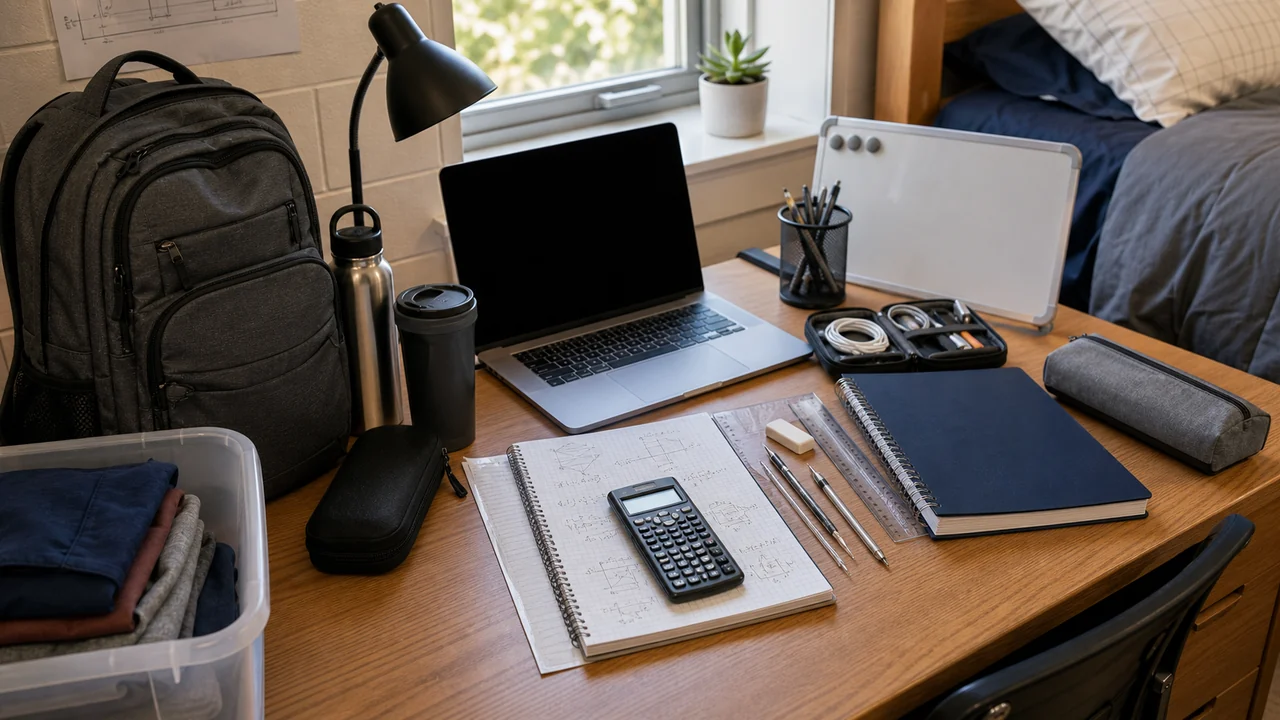
Engineering freshmen do not need a dorm room full of gadgets. You need a reliable way to sleep, a small desk setup that makes problem sets tolerable, a calculator you can learn early, and enough organization that your backpack does not become a paper landfill by October.
Affiliate disclosure: Some product links are Amazon affiliate links. We may earn from qualifying purchases.
Before you buy anything
- Check the residence hall list. Some dorms ban extension cords, certain appliances, candles, routers, or lofting hardware.
- Coordinate with your roommate. You probably do not need two mini fridges, two microwaves, and two printers.
- Wait on major-specific tools. Your first lab syllabus will tell you if you need goggles, a lab coat, a specific notebook, drafting tools, or software access.
The engineering study essentials
For a tighter class-supplies-only version of this list, see the engineering school supplies guide.
| Item | Why it matters | Shop |
|---|---|---|
| Scientific calculator | Learn one model deeply before exams | TI-36X Pro |
| Engineering paper | Keeps calculations aligned and readable | Computation paper |
| Mechanical pencils | Daily homework tool, not a luxury | Mechanical pencils |
| Small whiteboard | Great for free-body diagrams, circuits, and study groups | Dorm whiteboards |
| Backpack | Needs to carry laptop, charger, notebooks, and lab gear | Laptop backpacks |
| Desk lamp | Dorm overhead lighting is usually terrible | Desk lamps |
Calculator: buy early, learn slowly
Many engineering students eventually take the FE exam, and NCEES only allows specific calculator families on exam day. You do not need to obsess over licensure during freshman move-in, but it is smart to learn a calculator that can stay with you through classes and future exams. Start with our engineering calculator guide and TI-36X Pro tutorial.
Laptop and desk setup
Use your department’s laptop requirements before buying. Engineering software can be picky, especially for CAD, simulation, and Windows-only tools. If you already have a workable laptop, you may be better off adding a good charger, mouse, and storage instead of replacing it immediately.
Dorm comfort that actually helps studying
Comfort matters because engineering workloads punish bad sleep. A mattress topper, reliable fan, blackout curtains, laundry bag, shower caddy, and good headphones can do more for your grades than another stack of notebooks.
Useful searches: Twin XL mattress toppers, quiet dorm fans, shower caddies, and study headphones.
What not to overbuy freshman year
- Printers: many campuses have better shared printing than a dorm printer.
- Lab gear: wait for the syllabus unless your department gives a specific list.
- Textbooks: wait until you know whether the professor requires the newest edition, homework access code, or a library option.
- Huge tool kits: fun, but often unnecessary until clubs, labs, or internships tell you what you actually use.
Freshman-year study habit to start now
Every week, pick one class and rewrite the most important formulas, units, and mistakes onto one page. That habit becomes gold later for finals, internships, and eventually the FE exam.
For a light academic warm-up before move-in, see what to review the summer before engineering college.
What to buy now and what to wait on
Buy the items that remove friction from the first month: an approved scientific calculator, reliable pencils, engineering paper or a tablet workflow, a laptop that meets department guidance, and a backpack that protects it. Wait on specialized lab coats, safety glasses, drafting tools, and expensive software accessories until a syllabus or department list confirms the requirement.
The calculator is the one item worth buying early because it rewards slow practice. Learn it during homework, not during the first exam week. Put a small card in your notebook with the keys you use most: scientific notation, trig mode, solver, matrix entry, statistics, and stored variables. Those habits carry into the FE exam later.
For your desk, prioritize a setup that makes long problem-solving sessions readable. You need space for a laptop, calculator, notebook, and textbook at the same time. If you study in a dorm, add a small lamp and a physical place to store old quizzes and formula sheets. Engineering work creates paper fast, and losing old mistakes makes review harder.
A budget order that keeps costs under control
Start with required items, then comfort items, then upgrades. Required items include the calculator, laptop, safety gear from the syllabus, and any department-specific software or lab notebook. Comfort items include a lamp, chair cushion, headphones, and cable organization. Upgrades include monitors, tablets, and premium desk accessories.
This order protects your money during the first semester. Engineering students often discover that the professor, lab, or employer has a preferred format. Waiting two weeks can prevent buying the wrong notebook, goggles, adapter, or software add-on.
Choose supplies that still help when exam prep starts
A few purchases keep paying off beyond freshman year. A calculator you know well, a stable note system, a clear file structure, and a comfortable study setup all carry into FE preparation. You do not need a perfect desk, but you do need a repeatable place to solve problems without hunting for tools.
As classes begin, save old worked examples, unit-conversion notes, and formula sheets by course. Those records become a fast refresher when you later review statics, fluids, circuits, thermodynamics, materials, or engineering economics for the FE exam.
Start Building Engineering Problem-Solving Habits
Try free FE-style practice to see how engineering fundamentals show up in timed questions, calculator steps, and formula recognition.